
Introducción
LED displays power everything from outdoor billboards to control rooms. Among the most common architectures, two stand out: SMD (Surface-Mount Device) and COB (Chip On Board). Both create bright, full-color images, but they differ in how they’re built, how they perform, and where they make the most sense.
Where they sit in the market: SMD LEDs dominate larger-pitch and cost-sensitive deployments like outdoor advertising and rental staging. COB LEDs are gaining ground in fine-pitch, high-reliability indoor applications such as command centers and premium conference rooms, thanks to better protection, contrast, and durability.
Technology Structure: How SMD and COB Are Built
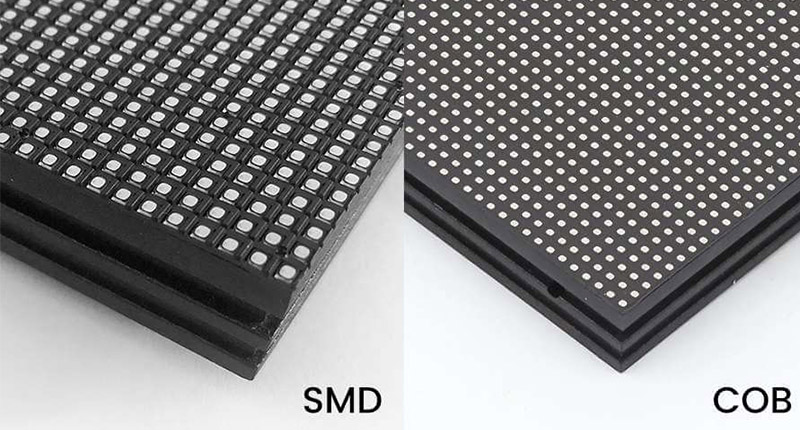
SMD (Surface-Mount Device) Structure: Each LED “lamp bead” is a packaged component soldered onto the PCB. You can see clear physical boundaries between individual LEDs. What this means: Modular and repairable. If one LED fails, technicians can replace the single component. It’s a mature, widely adopted process with strong supply chains.

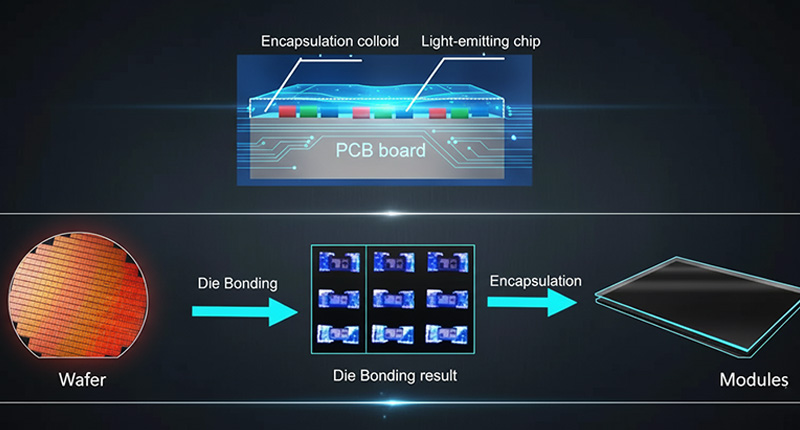
COB (Chip On Board) Structure: Bare RGB chips are directly bonded to the PCB and then encapsulated as a single, seamless surface. There are no individually packaged lamp beads. What this means: A smooth, continuous black surface that improves contrast and protection. Fewer optical edges and less stray reflection, which helps with image quality—especially at smaller pixel pitches.
Core Performance Differences
SMD Limitations
1.Fine pitch challenges below P1.0: As pixel pitch (the distance between pixel centers) drops below 1.0 mm, SMD manufacturing becomes increasingly complex and expensive.
2.Lower protection rating: Typical SMD indoor displays sit around IP43, which offers limited protection against dust and moisture. Learn more about IP ratings via official standards bodies or IEC documentation.
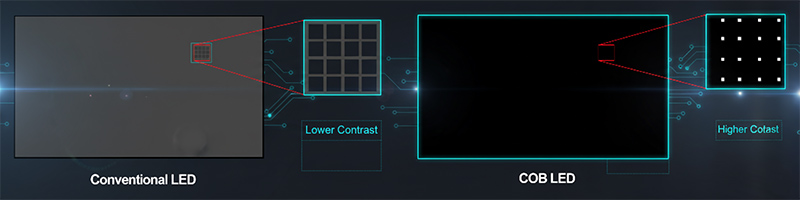
3.Contrast around ~1000:1: The LED’s plastic housing can reflect light, reducing perceived black levels and contrast.
4.Maintenance and value sweet spot: SMD excels at P2.5 and above, where costs are lower and single-LED replacement keeps service simple and cheap.
COB Advantages (and a trade-off)
1.Easy sub-P1.0 fine pitch: COB naturally supports P1.0 and below, enabling ultra-fine detail for close viewing distances.
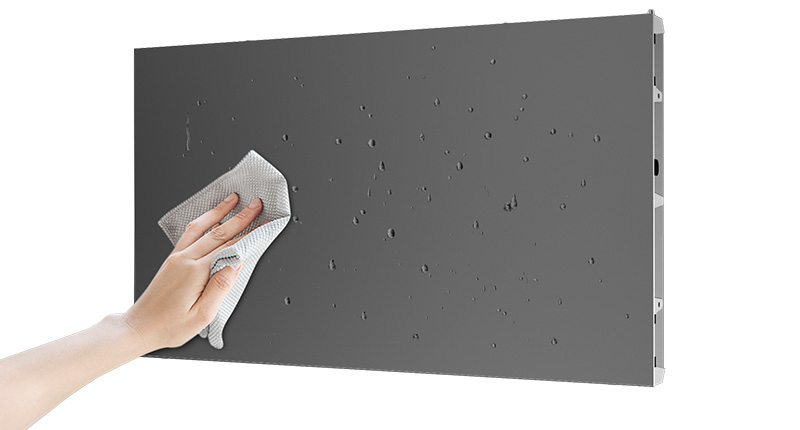
2.Higher protection: Typical COB modules reach IP65-level protection, shielding against dust ingress and low-pressure water jets—useful for durability and long-term reliability.
3.Higher contrast, deeper blacks: No reflective LED brackets. It’s a flat, dark surface that helps achieve contrast ratios over 3000:1, improving perceived dynamic range and readability.
4. Better thermal path and durability: Chips connect directly to the PCB, improving heat dissipation and extending lifespan. COB’s unified surface also resists vibration and temperature swings, making it a robust choice for 24/7 environments.
5.Module-level repair: If a small area fails, you typically replace an entire module, not a single LED. This can raise maintenance costs compared to SMD.
SMD Best-Fit Use Cases
1.Outdoor advertising screens: Cost-effective for larger pixel pitches (e.g., P4, P6, P8) where long viewing distances make fine pitch unnecessary. Easy single-LED repairs keep service costs low.
2.Stage and rental screens: Frequent assembly and teardown demand easy maintenance and affordable replacement. SMD Led Screen’s mature ecosystem and lower unit costs are a strong match.
COB Best-Fit Use Cases
1.Command and control centers: Operators sit close to the wall for long hours. COB’s fine pitch (P1.0 and below), 3000:1+ contrast, and robust IP65 protection deliver crisp text, stable images, and high reliability for 24/7 operation. Real-world example: A city traffic command center deploys a P0.9 COB wall to visualize multi-source video, GIS maps, and alerts. The high contrast preserves fine road markings and small fonts, while superior thermal performance supports continuous uptime.
2.High-end conference rooms and executive briefing centers: Near-field viewing demands tight pixel pitch and uniform blacks. Pantalla LED COB’s anti-reflection surface boosts legibility of spreadsheets, CAD drawings, and video conferencing feeds. The rugged, sealed surface also resists accidental touch and cleaning-related wear.
Market Trends
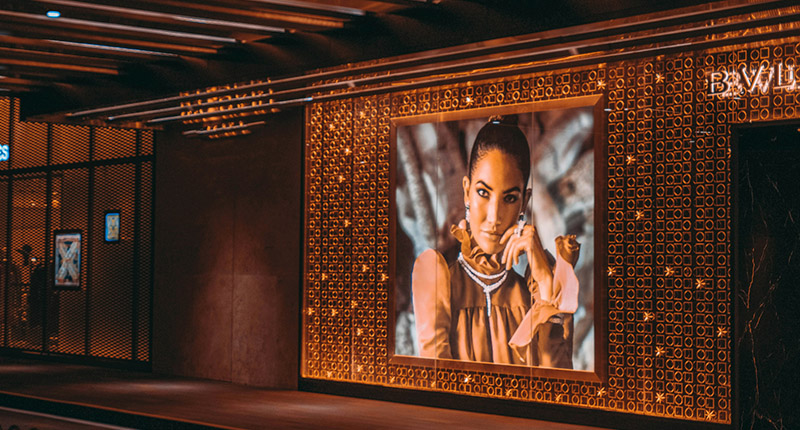
As COB manufacturing matures, costs are trending down. This is accelerating COB’s share in the small-pitch segment (P2.5 and below), where its structural advantages—higher contrast, higher protection, better thermal paths—translate into a visible, practical benefit. SMD remains strong in larger-pitch, price-sensitive, and maintenance-intensive deployments thanks to its scalability and easy component-level repair.
Summary and Buying Advice
- If you need small pixel pitch (around P2.5 or below), high contrast, and high reliability—choose COB.
- If you’re targeting larger pixel pitches (P2.5 and above), want lower upfront costs, and value easy single-LED repair—choose SMD.
- Consider your environment: Indoor premium/mission-critical spaces benefit from COB’s IP65-like protection, deep blacks (3000:1+ contrast), and vibration/temperature resilience. Outdoor and rental applications often favor SMD for cost efficiency and fast service.
- Budget and maintenance: COB modules can be pricier to repair (module swap), while SMD offers granular, single-LED fixes at lower part costs.
FAQ
- Why is Pantalla LED COB better for high-end rooms and control centers?
Because it supports sub-P1.0 pitch, delivers 3000:1+ contrast without bracket reflections, and has superior heat dissipation for 24/7 uptime. - When is SMD Led Screen the better value?
For P2.5 and above, especially outdoors or in rental markets where cost and quick single-LED replacement matter most.
Bottom line COB and SMD are both proven LED display technologies. Your best choice depends on viewing distance (pixel pitch), environment (protection and durability), maintenance strategy, and budget. Use COB for premium, fine-pitch, high-reliability visuals; use SMD for cost-effective, larger-pitch deployments that demand easy field service.
Si deseas saber más información y precios ¡contáctanos!