
Last Tuesday, it was Maria. She owns a skincare boutique in East London and she sent me a photo of her window: cracked lightbox frame, faded poster from last Christmas. “I want that transparent thing,” she texted. “The one that looks like magic on your LinkedIn.”
“Cool,” I replied. “How many times did you actually change it last year?”
[ten minutes later] “Um like 2 or 3 times maybe?”
That’s when I knew I needed to write this. Not a brochure. Not a spec sheet. Just what I actually tell people when they pull me aside at trade shows and ask for the advice.
At OneDisplay, we build LED displays. Obviously, I believe in what we make. But I’m also the person who has to look at customer return data and support tickets, which means I’ve developed a very specific allergy to selling someone the wrong screen. So here is exactly how I think about these three technologies—and where our own led screen fits in.
What these things actually are
Traditional Lightbox
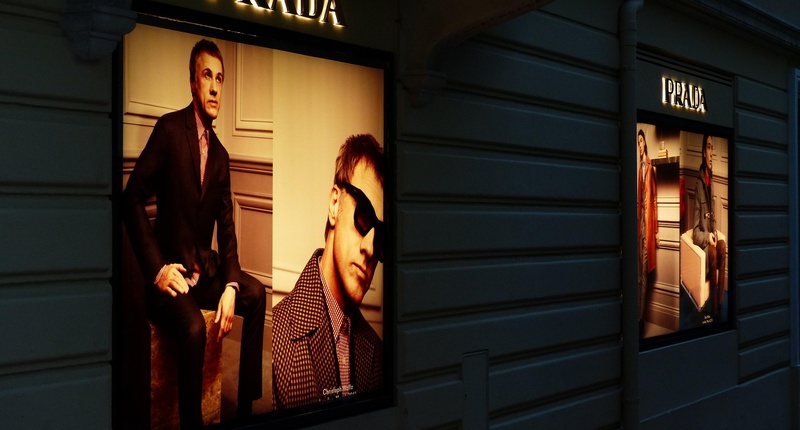
Let’s start with the technology we don’t sell. The lightbox is very simple: a printed film, some LED tubes behind it, a power cord. It’s been the retail default for two decades because it’s cheap, reliable, and asks nothing of you. No passwords. No firmware. No Wi-Fi.
But, i remember this one bubble tea shop we worked with—before I was at OneDisplay, I mean. Five locations, did this big spring thing. Looked amazing. Two weeks later their HQ killed the campaign. We had all these prints sitting around, probably eight hundred bucks worth, just sitting in a office for… honestly I forget how long. Months maybe? Someone finally threw them out.
That’s the part nobody puts in the brochure: every content change is a physical event. New print. Labor. A ladder. That faint smell of adhesive when you peel the old graphic off at midnight. For a retailer updating weekly, it is a recurring operational cost.
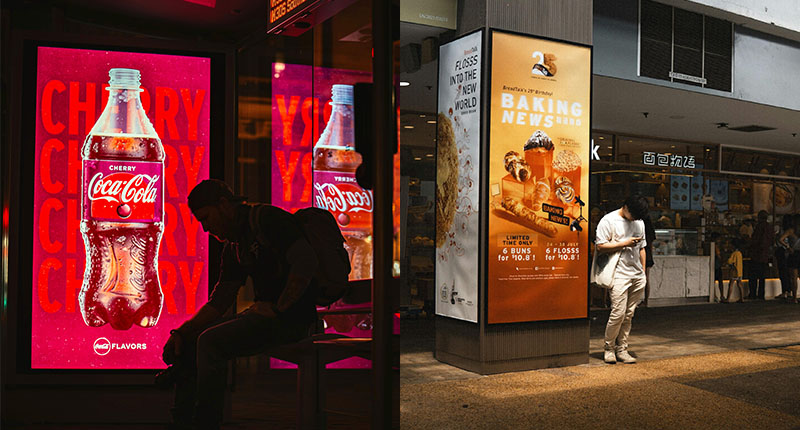
Standard LED Poster
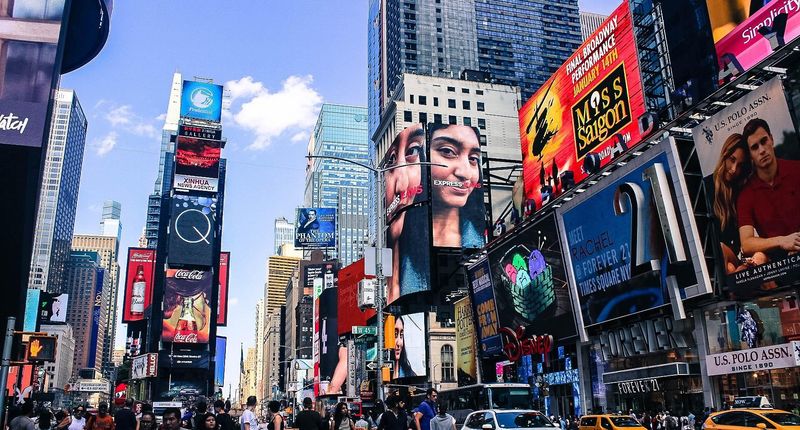
An LED poster is basically a very bright, very tall television built for commercial environments. Portrait orientation, floor-standing, roughly 1 m × 2 m. Upload a video, set a loop, change it from your phone.
They solve the content-update problem elegantly. But a black rectangle eating your floor space. When it’s off, it looks like a dead monolith. In a cramped shop, that footprint matters.
I’ve also seen retailers kill the technology’s advantage by uploading a 720p slideshow exported from PowerPoint. A bad video on a good screen looks worse than a beautiful print.
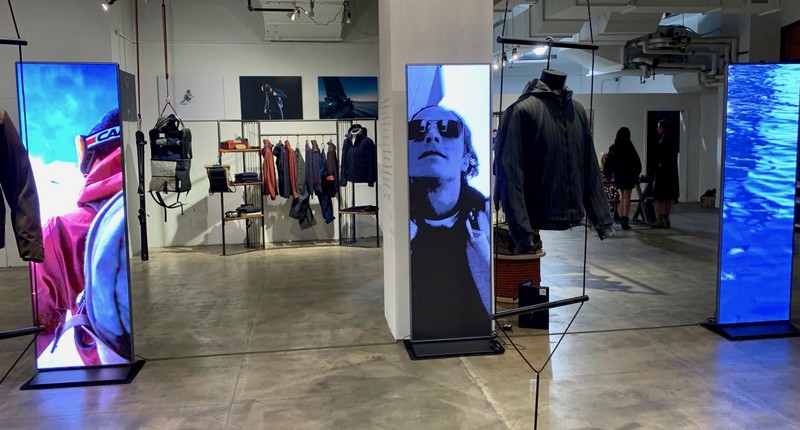
Holographic transparent LED Poster
When we started developing the O-Raster series, the brief wasn’t “make something cool for Instagram.” It was “make a screen that stops ruining the architecture.” Our engineering team spent eighteen months on a very specific problem: how do you deliver dynamic digital content without turning a boutique interior into a TV showroom?
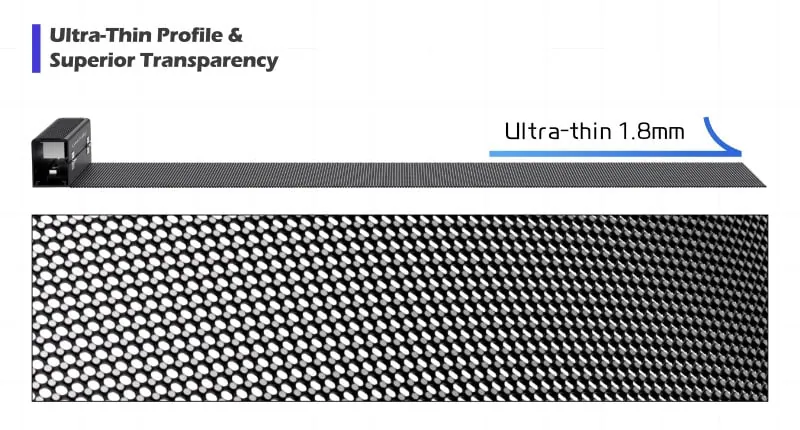
The result is a module that’s 1.8 mm thick, weighing roughly 0.5 kg per panel, with a transparency rating above 92%. The LED dots are small and sparse enough that, when the screen is displaying dark or neutral content, you’re looking straight through it. When bright elements play the display, they appear to float.
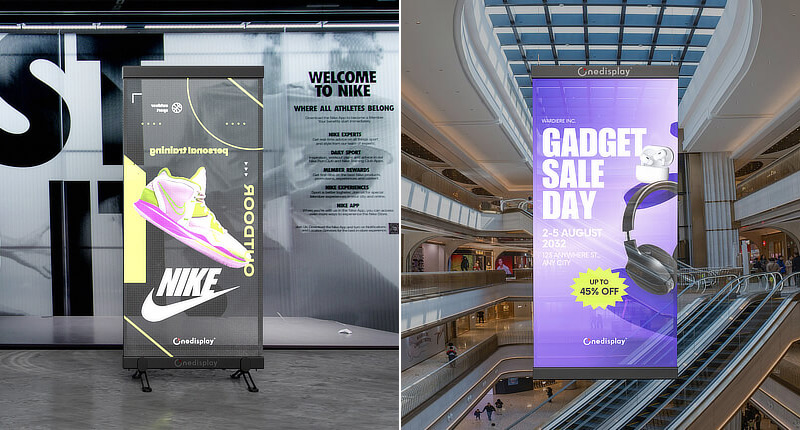
The screen can stand on the floor or hang from a ceiling, and it connects via Wi-Fi, HDMI, or network cable for content updates. The concept is that you get the impact of digital content without the screen overpowering the physical space — the display ‘disappears’ when it is not actively showing something bright.
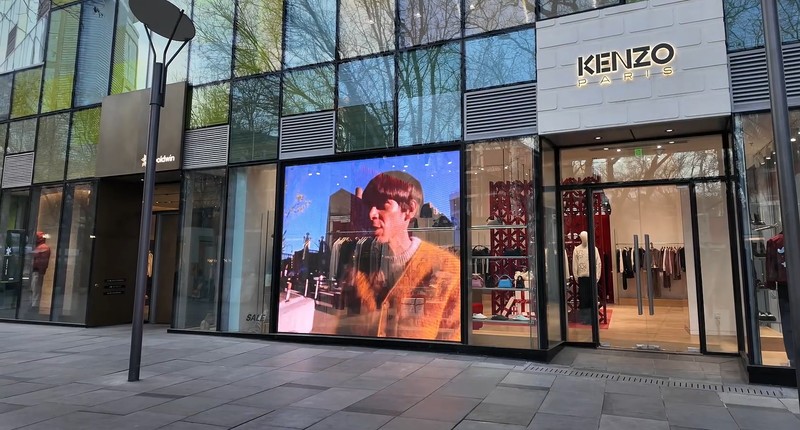
What are the key factors that attract customers?
What static light can and cannot do
A well-printed backlit graphic can be genuinely stunning. The color depth is better than most mid-range digital screens, and in a dim bar or restaurant, it glows. The problem is if you get used to seeing something with your eyes, you stop paying attention to it. The first time someone sees your lightbox, they notice. The twentieth time, it’s wallpaper.
If you’re on a high-traffic street where 80% of passersby are repeat visitors, a static image has a half-life measured in weeks, not months.
The dynamic advantage of LED posters
Motion works better though. Honestly, in most situations it just does. A good video loop—a real one, not a slideshow someone exported from PowerPoint—will catch way more eyes than a still image. Way more.
But the practical ceiling depends entirely on content quality. When the content is actually good—short product demos, looped brand films, seasonal motion graphics—the LED poster earns its keep. In a mall corridor where every store is screaming for attention, motion is currency.
The spatial effect of transparent holographic displays
The O-Raster doesn’t just display content; It blends in with its surroundings. In a white-walled minimalist boutique, a museum gift shop, or a flagship lobby, the screen disappears and the bright elements float. People pause. They point. They film it.
But I’ve also seen renderings from well-meaning designers who want to install our transparent panels in cluttered convenience stores bathed in fluorescent light. In that environment, the “holographic” effect is wasted. You’ve just bought an expensive screen with lower contrast than a standard LED poster. It’s bad business for us to sell a premium product into a context where it will look mediocre.
Total cost of ownership: the calculation most retailers never do
Upfront hardware
1. A basic lightbox setup—call it a meter by two, double-sided—runs you somewhere between three hundred and maybe twelve hundred depending on where you buy. If you’re a small shop needing two or three of these, you’re probably looking at three grand, give or take.
2. Standard LED poster: 1,500–3,000 for a decent indoor unit. Outdoor-rated or oversized? Easily $10,000+.
3. OneDisplay O-Raster holographic transparent poster: 4,000–12,000 per unit depending on size, pixel pitch, and installation. I’m not going to pretend that’s cheap. It’s firmly premium territory.
Prints. Everyone forgets the prints.
A single backlit graphic costs roughly 50–300. Update eight times a year? That’s 400–2,400 annually per unit, plus labor. I budget 1–2 hours of someone’s time per swap.
Run that for five years: 2,000–12,000 in post-purchase costs for a single lightbox. I know a chain with fifty stores updating six times a year. Their five-year print bill crossed six figures. The lightboxes themselves were basically free by comparison.
Digital displays—whether a standard LED poster or our O-Raster—kill that recurring cost entirely. Upload via software. Schedule remotely. Done. The only ongoing hit is electricity.
The break-even calculation
If you update four times a year, the math is brutal. Say a lightbox costs you 500/year in prints and labor, and an LED solution costs 300/year in electricity. You’re saving 200/year. Against a hardware premium of 2,000–5,000, your payback is ten to twenty-five years.
But if you’re in fast fashion or fast-casual food, updating every three weeks—sixteen times a year—that annual print cost jumps to 1,000–2,000. Now the digital display pays for itself in two to five years. That’s real ROI.
If a prospect tells us they update twice a year, we actively tell them to buy a lightbox or a standard poster for now, and call us when their content strategy accelerates.
전기
Surprisingly small difference. A lightbox pulls maybe 50–150W. A standard LED poster? 200–600W. Our O-Raster sits in a similar range depending on brightness settings. Running twelve hours a day, the annual gap between any of these technologies is roughly 100–400. Not nothing, but not a dealbreaker.
Operational complexity: what happens the day after you buy
Content management reality
Traditional lightboxes require no software, no passwords, no network configuration, and no firmware updates. A staff member removes the old graphic and slides in the new one.
Standard LED poster displays 그리고 holographic transparent LED posters both require a content management system. The good news is that most modern systems — including the O-Raster series — are designed for non-technical users. Content is uploaded via a smartphone app or web portal, scheduled in advance, and pushed to the screen over Wi-Fi or network cable. For a store manager with basic digital literacy, the workflow is manageable.
Hardware maintenance
Traditional lightboxes have two failure modes: the LED tubes eventually dim or fail, which requires opening the panel and replacing the tube strip; and the graphic film can develop bubbles or delaminate over time, which requires re-printing. Both are manageable with basic maintenance but do require occasional attention.
Standard LED poster displays have modular internal components — power supplies, receiving cards, individual LED modules — that can fail. A reputable manufacturer designs these systems for front or rear maintenance, meaning a technician can replace the failing component without removing the entire screen. Component lifetimes vary, but power supplies in LED displays typically last three to five years in indoor environments.
Holographic transparent LED displays share similar maintenance architecture to standard LED posters, but the ultra-thin module design requires more careful handling during service.
Space and environment considerations
Lightboxes hug the wall. Five to fifteen centimeters deep. Zero floor impact.
An LED poster display is a freestanding unit by default, which means it occupies floor space — roughly a 60-centimeter by 200-centimeter footprint for a standard portrait-format poster. This is fine for large stores with ample circulation space, but it can be problematic for small boutiques, narrow shopfronts, or tightly optimized floor plans.
A holographic transparent LED poster can be either floor-standing or ceiling-hanging, giving it more flexibility in small spaces. Because it is transparent, it does not create the same visual block that a standard LED poster does when viewed from outside the display window.
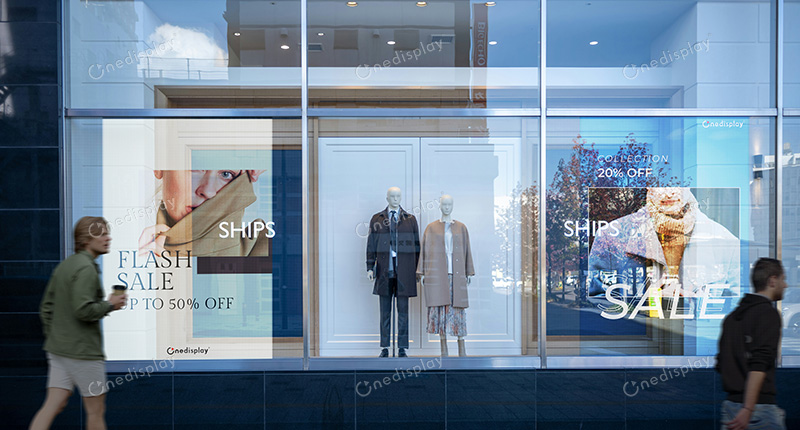
Which should you choose: an decision framework
Here is a straightforward way to think through the decision, organized around the scenarios where each technology actually wins.
Choose a traditional lightbox if
Your store updates promotional content fewer than four times per year. Your budget for hardware is under $5,000 total. You have limited floor space and cannot accommodate a freestanding unit. Your store has an established visual language built around print quality and you are not under pressure to create video content. You have no staff member who could reasonably manage a digital content system.
1. You update content fewer than four times a year.
2. Your total hardware budget is under $5,000.
3. You have no floor space for freestanding hardware.
4. You have nobody on staff who can manage a smartphone app.
In these circumstances, a traditional lightbox is not a compromise. It is a sensible choice that does the job at the right price.
Choose a standard LED poster display if
1. You update six or more times a year.
2. You want to show video, motion graphics, or product demos.
3. You have floor space to spare.
4. Someone on staff or on retainer can handle content updates.
5. You run multiple locations and need central control.
For most mid-sized fashion, electronics, home goods, or food-service retailers, this is the sweet spot. The economics work above roughly six updates per year, and the operational model is manageable.
Choose a holographic transparent LED poster if
1. You operate a premium, luxury, or concept space where the environment is the marketing.
2. You have a flagship location and you want people to organically film your window.
3. Your content strategy leans on dark backgrounds, floating product reveals, or atmospheric brand storytelling.
4. You need to preserve sightlines, natural light, or visibility through glass while still showing dynamic content.
5. You have the budget for a premium product for a specific use case, not a broad chain-wide rollout.
For the right brand, in the right space, with the right content strategy, the O-Raster holographic transparent LED poster creates a visual identity that is hard to achieve with any other technology currently available.
What this trend tells us about the future
Early digital signage replaced posters with glowing rectangles. It worked, but it made stores feel like airports—every surface screaming. The best retail design has always understood that space itself is part of the brand.
Transparent LED tech is the industry’s apology for that aggression. By making the screen vanish when it’s not needed, designers can finally have both: digital flexibility and architectural calm.
Holographic Transparent Screen – at 1.8 mm, 0.5 kg per module, and 92% transparency – is our answer to that tension. We built it for retailers who’ve already figured out who they are, and who need a display that serves the space instead of dominating it.
Finally, Three questions I ask every prospect
Take these three questions, they cut through the noise faster than any spec sheet:
1. How many times per year do you actually change your promotional content? If the answer is fewer than six, the economics of digital displays—ours included—are not yet compelling for you.
2. 고객이 당신의 디스플레이를 봤을 때 어떤 느낌을 받기를 원하십니까? 만약 답변에 "감탄했다", "놀랐다", 또는 "뭔가 다르다"와 같은 표현이 포함된다면, 당신은 투명 홀로그램 디스플레이가 일반 포스터나 라이트박스보다 더 잘 제공할 수 있는 기술적 프리미엄을 설명하고 있는 것입니다.
3. 디지털 하드웨어에 대한 현실적인 지원 역량은 어느 정도입니까? 콘텐츠 업데이트를 위한 스마트폰 앱을 관리할 사람이 없고, 신속한 제조업체 지원을 위한 예산도 없다면, 디지털 디스플레이는 결국 사용자에게 불편함을 초래하여 본래의 이점을 약화시킬 것입니다.
그 질문들에 솔직하게 답하면 무엇을 사야 할지 정확히 알 수 있을 겁니다.
그리고 만약 당신의 답변이 다음을 가리킨다면 오-래스터저희를 찾는 방법을 아시잖아요.