
Now, you have the quote, one supplier says $600 per square meter, another quotes $4,500 for the same size. For a 20 m² video wall, that is a $78,000 swing in your budget. If you are researching LED screen price 2026 data now, you already know the core problem: pricing transparency in this industry is practically nonexistent.
We break down exactly how much an LED screen costs in 2026 – from entry-level outdoor billboards at $350/m² to ultra-premium indoor COB displays approaching $9,500/m². Whether you are an AV integrator building a quote or a business owner buying your first LED video wall, you will find specific numbers here, not vague estimates.
1. Why LED Display Pricing Demands a Dedicated Guide in 2026
The global LED display market is projected to reach $9.86 billion in 2026, growing at 4.9% CAGR toward $15.15 billion by 2035. Advertising media applications command 34.8% of total demand, spanning retail, stadium, and DOOH deployments. Chinese manufacturers now control roughly 59% of the global mid-to-low-end segment, a concentration that has supercharged price competition.[1]
Samsung reported LED display prices fell roughly 50% in the five years leading into 2021, and that trajectory continues. The outdoor LED segment, valued at $15.36 billion in 2026 with an 11.5% CAGR, sees further reductions from energy-efficient common-cathode designs that cut power use by up to 40%. At the premium end, fine-pitch indoor screens (sub-P1.5 mm) are growing at 24.0% CAGR, pushing COB and emerging MIP technologies into broader adoption. [2][3]
With this much market movement, static price lists from prior years mislead more than they help. Buyers need current, category-specific LED display cost per square meter data that accounts for pixel pitch, installation environment, and hidden expenses that can add 20–50% on top of the panel price.
What This Guide Covers
Over the following six chapters, we deliver exactly that. Chapter 2 provides detailed LED video wall price tables for indoor, outdoor, rental, and specialty displays. Chapter 3 unpacks ten cost drivers, from pixel density and LED packaging technology to driver IC quality and cabinet materials. Chapter 4 exposes the hidden costs most quotes bury. Chapter 5 analyzes where 2026 prices are headed. Chapter 6 covers the critical new factor reshaping the market: geopolitical shocks and raw material inflation. Chapter 7 gives you a practical buying framework.
2. LED Screen Prices by Type (Per Square Meter) — 2026 Data
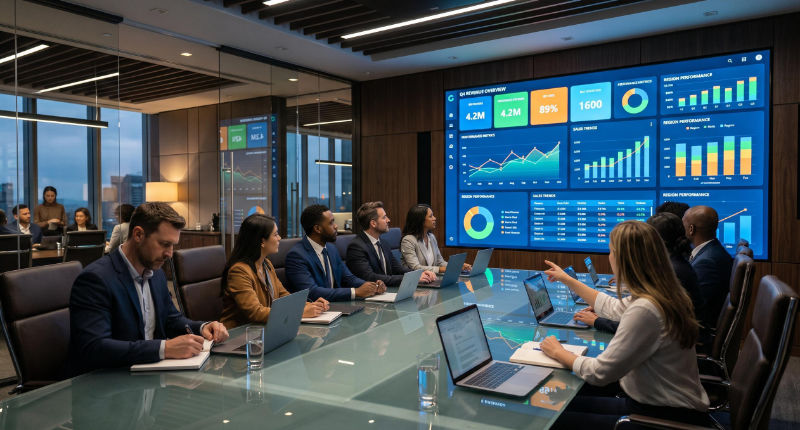
In 2026, LED display cost per square meter ranges from roughly $350 for large-format outdoor billboards to $9,500 for ultra-premium COB MicroLED, by pixel density, packaging technology, and weatherproofing.
The master table below covers every major LED screen category by type, pixel pitch, and 2026 price range.
| LED Screen Category | 픽셀 피치 | Price Range (USD/m²) | Best Application |
| Indoor — Entry-level | P2.5–P4 | $600–$1,200 | Conference rooms, hotel lobbies, retail signage |
| Indoor — Mid-range | P1.5–P2.5 | $1,200–$2,500 | Corporate boardrooms, control rooms, replacing LCD video walls |
| Indoor — High-definition (COB) | P0.9–P1.2 | $2,000–$4,000 | Broadcast studios, command centers, luxury retail |
| Indoor — Ultra-premium COB MicroLED | P0.7 | $7,800–$9,500 | Executive boardrooms, R&D labs, flagship installations |
| Outdoor — Large-format billboard | P8–P10 | $350–$950 | Highway advertising, stadiums, long-distance viewing |
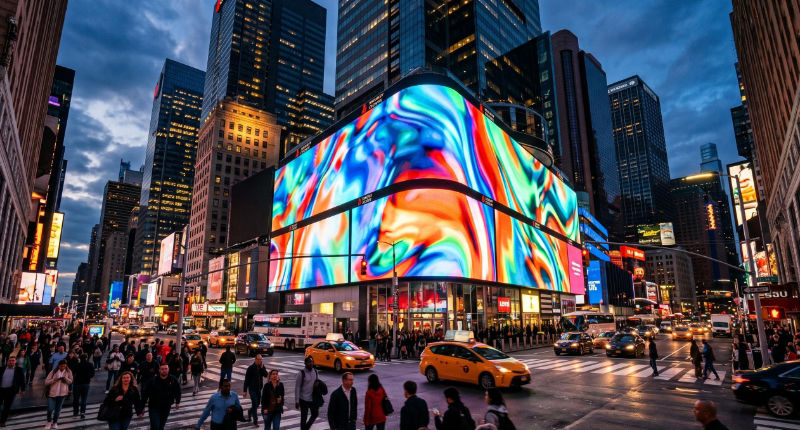
| Outdoor — Standard commercial | P5–P6 | $500–$1,300 | City plazas, building facades, commercial districts |
| Outdoor — High-resolution | P3.9–P5 | $800–$1,800 | Premium brand stores, close-proximity urban installs |
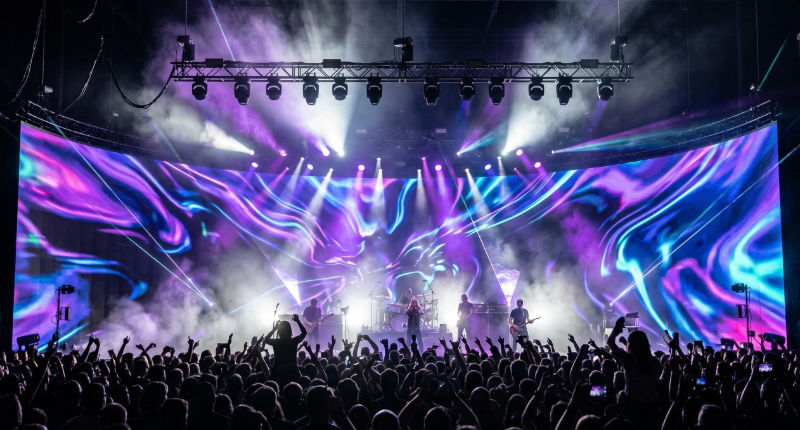
| Rental — Event-grade | P2.6–P3.9 | $800–$1,800 | Concerts, trade shows, temporary installations |
| Rental — Budget-friendly | P2.6–P4.8 | $650–$950 | Smaller events, corporate presentations, road shows |
| Specialty — Transparent LED | Varies | $600–$4,000 | Retail windows, architectural integration, museums |
| Specialty — LED poster | P1.8–P2.5 | $900–$1,500 | Retail, exhibitions, digital poster replacements |
| Specialty — LED dance floor | P3–P6 | $800–$1,600 | Events, nightclubs, immersive experiences |
Smaller pixel pitch means more LEDs per square meter and exponentially higher manufacturing precision. A P0.7 panel packs roughly 2 million pixels per square meter, while P10 manages only 10,000 — a 200x density gap that explains most of the cost difference.
2.1 Indoor LED Display Prices
Entry-Level Indoor P2.5. Entry-level indoor panels at $600–$1,200/m² suit viewing distances of 3–10 meters, ideal for conference rooms and retail signage. Roughly 160,000 pixels per square meter — is the standard for buyers wanting LED’s seamless, bezel-free advantage without premium pricing.
Mid-Range Indoor (P1.5–P2.5): $1,200–$2,500/m². This tier has replaced LCD video walls in corporate deployments. P1.8 and P2.0 panels deliver 277,000–400,000 pixels per square meter that stay sharp at 1.5–2 meter distances. The price jump buys better LED chips, die-cast aluminum cabinets, and 3840Hz refresh rates versus standard 1920Hz — critical if your screen appears on camera.
High-Definition Indoor (P0.9–P1.2 COB): $2,000–$7,000/m². Below P1.2 you enter COB (Chip on Board) territory — chips mounted directly onto the PCB without housings. COB delivers superior durability but commands a premium: P1.0–P1.2 at $2,000–$4,000/m², P0.9 at $4,500–$7,000/m². These suit broadcast studios where viewers stand within 1 meter.
Ultra-Premium COB MicroLED (P0.7): $7,800–$9,500/m². P0.7 at $7,800–$9,500/m² represents the cutting edge of commercial LED technology. Exponential cost reflects manufacturing complexity: yields drop as chip spacing shrinks to micron tolerances. These panels serve executive briefing centers where visual perfection outweighs budget.
2.2 Outdoor LED Display Prices
Large-Format Outdoor Billboards (P8–P10): $350–$950/m². A P10 highway billboard at $350–$850/m² works fine when viewers see it from 30–100 meters. The challenge is brightness (5,000+ nits) and weatherproofing (IP65). Energy-saving P8 vriants at $600–$950 cut power draw by up to 40% — a meaningful TCO advantage.
Standard Outdoor Commercial (P5–P6): $500–$1,300/m². P5–P6 covers the bulk of urban commercial installs — city plazas and building facades viewed from 5–15 meters. The $500–$1,300 range reflects build quality: steel cabinets at the low end, die-cast aluminum with front-service access near $1,300.
High-Resolution Outdoor (P3.9–P5): $800–$1,800/m². P3.9–P5 at $800–$1,800/m² serves premium brand storefronts where passersby view content from under 5 meters. The premium over P5–P6 reflects the difficulty of achieving fine pixel pitch while maintaining IP65 weatherproofing and 5,000+ nit output.
2.3 Rental & Specialty LED Prices
Rental LED Displays (P2.6–P3.9): $800–$1,800/m². Rental screens at $800–$1,800/m² pay for lightweight cabinets, quick-lock mechanisms, and edge protection for repeated assembly. Budget P2.6–P4.8 options at $650–$950 work for smaller corporate events.
Transparent LED Screens: $600–$4,000/m². Transparent LED at $600–$4,000/m² spans the widest range of any category. Basic P3.91 transparent mesh panels at ~$600 offer 60–70% transparency; high-resolution P3.91 holographic Invisible panels approach $4000 for luxury retail windows where sight lines matter.
LED Poster Displays (P1.8–P2.5): $900–$1,500/m². LED poster displays — freestanding units replacing printed posters — cost $900–$1,500/m². These all-in-one units include integrated media players and WiFi, gaining traction in retail where dynamic visuals beat static signage.
Matching Pixel Pitch to Viewing Distance
Choose pixel pitch based on viewing distance. The industry rule: minimum viewing distance in meters equals pixel pitch in millimeters. A P2.5 screen looks sharp from 2.5 meters; P10 from 10 meters. For viewers within 1 meter, P0.9–P1.2 COB is the minimum. For highway billboards at 50+ meters, P8–P10 delivers sufficient resolution at roughly one-tenth the cost of fine-pitch indoor alternatives.
3. The 10 Factors That Determine LED Screen Price
Two quotes for the same screen size can differ by 300%. Every choice moves the needle on your LED display cost per square meter. Here are the ten drivers behind LED screen price 2026 — ranked by impact so you can cut budget without cutting corners.
| Rank | Cost Factor | Impact | Typical Price Swing |
| 1 | 픽셀 피치 | Very High | 3–5x between P5 and P2 for same brand |
| 2 | LED packaging (SMD vs GOB vs COB) | High | COB 18–22% above SMD; GOB mid-point |
| 3 | LED chip brand | High | Nationstar 15–25% premium over Kinglight |
| 4 | Brightness requirement (indoor vs outdoor) | High | Outdoor needs 5,000+ nit LEDs, waterproofing |
| 5 | 캐비닛 재질 | 중간 | Die-cast aluminum premium over steel |
| 6 | IP rating (outdoor sealing) | 중간 | IP65/IP67 adds sealing cost vs IP31 indoor |
| 7 | 새로 고침 빈도 | 중간 | 3,840 Hz+ adds ~$15–25/m² over 1,920 Hz |
| 8 | Driver ICs and control system | 중간 | Novastar A5S or higher recommended |
| 9 | Installation type | 중간 | Rental hardware > fixed; creative shapes highest |
| 10 | Energy efficiency (Common Cathode) | Low–Medium | +10–15% upfront, saves 40% power |
3.1 Technical Specifications
Pixel pitch is the #1 cost driver. Pixel pitch (in millimeters) is the distance between adjacent LED pixels — smaller means tighter density but exponentially more LEDs per m². A P2 costs roughly 3x per m² as a P5 because it packs over 6x the lamp beads. Use the viewing distance formula: minimum comfortable viewing distance in meters ≈ the pixel pitch number. A P3 looks sharp from 3 meters; choosing P2.5 over P1.8 for a wall viewed from 4+ meters can cut how much does an LED screen cost by 30–40%.
LED packaging follows a clear cost hierarchy: SMD (lowest cost) < GOB < COB (highest cost, best durability). SMD places individual LED chips onto the PCB; GOB adds protective epoxy for high-traffic areas; COB mounts chips directly for superior heat dissipation. A P1.25 indoor screen shows the spread: SMD at $1,200–$2,500/m², GOB at $2,800/m²+, COB at P0.9 at $4,500–$7,000/m². COB’s 18–22% premium pays back in 24/7 installs through lower failure rates.
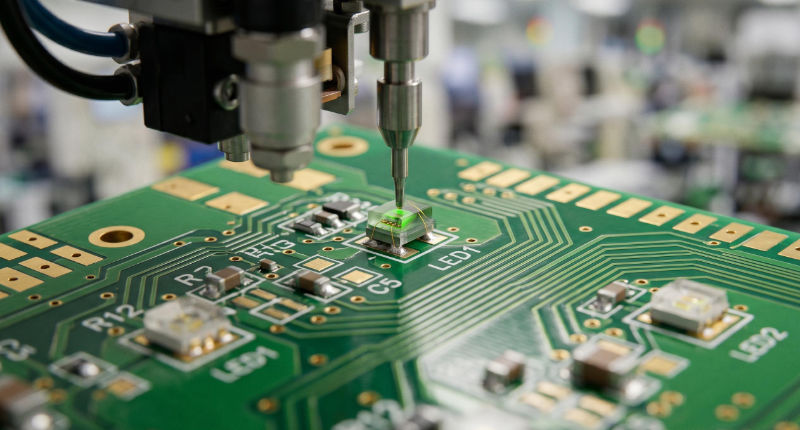
Refresh rate upgrades add modest cost. Standard panels ship at 1,920 Hz, adequate for signage. Upgrading to 3,840 Hz+ adds ~$15–25/m². Essential for broadcast where low refresh produces scan lines on camera; for pre-recorded lobby content, 1,920 Hz keeps your indoor LED display price at entry level.
Brightness requirements split the market. Indoor needs 600–1,200 nits; outdoor screens demand 5,000–10,000+ nits. Higher-grade chips and thermal management push outdoor LED screen price above indoor equivalents.
3.2 Component and Build Quality
LED chip brands create a three-tier pricing structure. Kinglight is a mid-range product; Nationstar commands a 15–25% premium for better color consistency; premium imports (Nichia, high-grade Epistar) add another step for color-critical uses. For a house of worship, Nationstar hits the sweet spot; for a billboard viewed from 20 meters, Kinglight is a defensible cut. However, we do not recommend using entry-level LED chips, as the maintenance costs will far exceed the purchase costs.
Driver ICs determine reliability. Novastar A5S or equivalent-grade ICs are the minimum where downtime is costly. Cheaper ICs save $10–20/m² upfront but produce uneven brightness and artifacts.
Cabinet material affects precision and weight. Die-cast aluminum offers tighter tolerances and lighter weight for hanging installs; steel costs less but may flex, causing visible seam lines. For rental and fine-pitch use, aluminum is effectively mandatory.
3.3 Installation and Environment Factors
IP rating determines sealing cost. Indoor screens carry IP31; outdoor needs IP65 (dust-tight, water-jet protected) or IP67 (immersion protected). The required sealing, gaskets, and drainage push outdoor LED screen price above indoor equivalents.
Installation type scales from simple to complex. Fixed wall mount is cheapest. Rental needs quick-lock mechanisms and front-access serviceability. Creative shapes require custom engineering and can multiply base LED display cost per square meter by 2–5x.
Energy efficiency trades upfront cost for savings. Common Cathode cuts power draw ~40% versus Common Anode but adds 10–15% upfront. On a 20 m² screen running 12 hours daily, payback lands at 18–24 months.
4. Hidden Costs That Add 20–50% to Your LED Project Budget
The LED panels themselves represent only 50–60% of your total project spend. The rest hides in mounting infrastructure, installation labor, control systems, shipping, and operational costs that rarely appear in the initial quote. When a supplier quotes $1,200/m² for a P2.5 indoor screen, that figure covers modules, cabinets, and power supplies — not the steel frame, video processor, or customs duty.
The Hidden Costs Breakdown Table
| Cost Item | Typical % of Screen Cost | Dollar Range | Notes |
| Steel mounting structure | 10–20% | $100–$800/m² | Varies by wall type; truss and ground stands cost more |
| Installation labor (flat wall) | 5–15% | $200–$500/m² | Standard flat-surface mounting; varies by region |
| Installation labor (curved/custom) | 20–40% | $700–$2,500/m² | Custom framing and geometries need specialist crews |
| Control system + video processor | 5–10% | $500–$5,000 total | Scales with resolution and input source count |
| Software / CMS licensing | 1–5% | $200–$2,000/yr | One-time or recurring; cloud-based CMS adds ongoing fees |
| Spare modules inventory | 3–8% | 5–10% of module count | Buy from same production batch to ensure color matching |
| Electrical infrastructure | 3–10% | $300–$3,000 total | Dedicated circuits and power distribution; often overlooked |
| Shipping and freight | 3–8% | $200–$1,500 | Ocean freight from Asia; air freight multiplies this 3–5x |
| Customs duties and import taxes | 2–7% | 5–15% of declared value | Depends on HS classification and trade agreements |
| Power consumption (5-year) | 15–30% | Varies by usage | 24/7 displays can match hardware cost within 5–7 years |
| Maintenance service contract | 2–5%/yr | $500–$3,000/yr | Front-serviceable designs cut labor and scaffold costs |
Infrastructure and Installation
Your mounting surface dictates your steel budget. A concrete wall installation runs 10–15% of screen cost, while complex facade integrations push toward 20%. Curved LED video walls require custom trussing and specialist crews, driving installation to $700–$2,500/m² — up to five times flat-wall rates. Commission a site survey before locking in your LED video wall price; structural surprises are expensive.
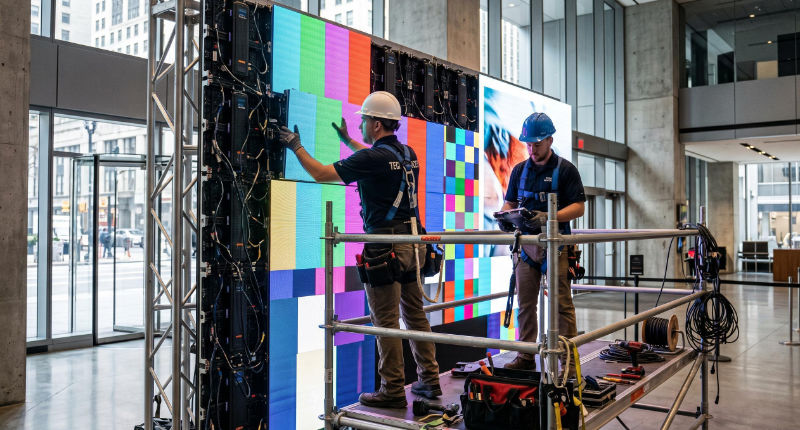
System Components
The control system — sender and receiver cards plus video processor — adds 5–10% to hardware cost. Entry-level video processors run $500; multi-input 4K scalers reach $5,000.
Spare modules inventory
Spare modules are non-negotiable: hold 5–10% of your total module count in reserve from the same production batch. LED batches vary in color temperature, and future replacements that do not match create visible seams on your wall.
Ongoing Operational Costs
Power is the most underestimated line item. For screens running 12–24 hours daily, cumulative energy costs can equal the original hardware investment within 5–7 years. A 20 m² outdoor screen at 600W/m² running 12 hours daily consumes roughly 52,000 kWh annually — about $6,760 at $0.13/kWh. Maintenance contracts run 2–5% of hardware cost annually; front-serviceable cabinets reduce this by eliminating rear access corridor requirements.
The Complete Project Budget Formula
Total Project Cost = Screen Cost + Steel Structure (10–20%) + Installation ($200–$2,500/m²) + Control System (5–10%) + Spare Modules (5–10%) + Shipping and Customs (5–15%) + First-Year Power and Maintenance
The Under-Budgeting Trap
A 30 m² indoor P2.5 wall quoted at $1,500/m² produces a $45,000 panel invoice. Apply mid-range hidden cost estimates and your actual first-year spend approaches $65,000–$72,000 — 44–60% above the headline figure. A 10 m² outdoor billboard follows the same pattern: $8,000 in panels becomes $12,000–$14,000 installed and operational. Demand a line-item breakdown from every vendor covering panels, structure, installation, control system, shipping, and first-year operating costs. Anything less is an opening bid, not a quote.
5. LED Screen Price Trends for 2026 and Beyond
If you are weighing whether to buy now or wait, understanding where LED screen prices are headed matters as much as today’s quote. The 2026 market is being pulled in two directions — forces driving costs lower and forces pushing premium segments higher. Knowing which affects your use case can save thousands.
What’s Driving Prices Down
Three structural trends are compressing LED display cost per square meter, and none show signs of reversing.
Chinese manufacturing scale. Chinese manufacturers control roughly 59% of the global mid-to-low-end market.[1] That concentration fuels intense competition among dozens of factories. We noted LED display prices fell roughly 50% in the four to five years preceding 2021,[2] and that trajectory continues as capacity expands.
MicroLED commercialization. TCL’s 163-inch MicroLED dropped from $110,000 to $36,000 in two years — a 67% price decline. While MicroLED remains ultra-premium, that erosion signals what happens when technology hits production scale, pressuring COB and fine-pitch SMD prices downward.[4]
Small-pitch affordability. The sub-P1.5 segment is growing at 24% CAGR. Rapid growth means economies of scale kick in fast — yields improve and equipment costs amortize across more panels. P0.9 COB that cost $7,000/m² two years ago now starts around $4,500/m².[3]
What’s Keeping Prices Up
Three factors are creating a price floor.
Premium brand positioning. Tier-one manufacturers like ROE Visual(Professional Rental), Absen(Professional Indoor), and OneDisplay(Professional Transparent Display) command a 15–25% premium over generic alternatives. Buyers get better calibration, stricter QC — worthwhile for mission-critical installs.
Energy efficiency mandates. Rising electricity costs are pushing efficiency standards higher. Common-cathode driving cuts power up to 40%, but efficient components cost more upfront, shifting expense from operating budgets to capex.[5]
Advanced packaging costs. COB production requires clean-room conditions and precision die-bonding that SMD lines do not. Until MIP (Micro LED in Package) scales, fine-pitch screens carry manufacturing overhead that competition cannot erase.
TCO vs Upfront Price
Upfront LED screen price is becoming the wrong metric. Total cost of ownership — power, maintenance, and lifespan over 5–10 years — is replacing sticker price as the buying criterion.
A quick ROI framework: a $3,000/m² screen drawing 400W/m² looks cheaper than a $4,000 unit at 250W/m². But over ten years at $0.15/kWh, the efficient screen saves ~$1,950/m² in electricity alone. Factor in fewer module replacements, and the premium unit pays for itself.
| Cost Factor | Typical Range | Share of 10-Year TCO |
| Upfront purchase | $600–$5,000/m² | 40–60% |
| Electricity | $150–$600/m²/year | 25–40% |
| Maintenance & spares | 5–10% of purchase/yr | 10–20% |
| Installation & structure | 10–30% of hardware | 5–10% |
The outdoor LED screen market is projected to grow at 11.5% CAGR through 2033,[2] drawing more buyers and incentivizing manufacturers to compete on lifetime value, not day-one price. The question is no longer “how much does an LED screen cost?” It is “what will this screen cost me every year I own it?”
6. Geopolitical Shocks & Raw Material Costs: The 2026 Wildcard
For most of the past decade, LED screen prices followed a predictable downward curve. That changed in 2025. A convergence of geopolitical conflicts, trade tariff escalations, and raw material inflation has introduced a new variable into LED pricing — one that buyers can no longer ignore. If you are budgeting for an LED project in 2026, understanding these external pressures is as important as comparing pixel pitches.
US-China Trade Tariffs: A Volatile New Reality
The LED display industry felt the full force of trade policy shifts in 2025. Beginning in February 2025, the United States imposed successive rounds of tariffs on Chinese imports, with cumulative rates peaking at 145% in April before a May Geneva agreement scaled them back to 30%.[6] A temporary truce extended through late 2025 and into 2026, but uncertainty persists.
This matters enormously because over 90% of LED displays and LED module accessories come from China. The US represents the third-largest export market for Chinese LED screens (11–14% of overseas exports). For US buyers, these tariffs have effectively doubled the landed cost of many LED products, forcing importers to either absorb margins, pass costs to customers, or seek alternative — and often less reliable — supply chains through Canada or Southeast Asia.[6]
Raw Material Inflation: The Supply Chain Squeeze
Beyond tariffs, upstream material costs are rising across every category that feeds into LED manufacturing. Industry reports confirm that Chinese LED suppliers raised prices 5–15% in 2026, with many quotations valid for only 24–48 hours. Here is the breakdown.
PCB and copper costs. Copper prices surged 30–35% year-over-year in 2025, with copper foil up ~35%, prepreg costs up ~40%, and copper-clad laminate (CCL) climbing as much as 45%. A major global CCL supplier announced an additional 10% price increase toward the end of 2025. Since PCB boards are one of the largest cost components in an LED display module, this feeds directly into higher panel prices.[7]
Precious metals in LED packaging. Gold, silver, and copper together account for more than 70% of LED packaging costs. Sharp price increases in these commodities have pushed up the cost of silver paste, alloy bonding wires, and PCB boards industry-wide. Major packaging companies including MLS and Kinglight implemented price adjustments of 5–10% as early as August 2025, with the rest of the supply chain following by December.[8]
Driver IC shortages. The global semiconductor shortage that affected automotive and consumer electronics has not spared LED displays. AI infrastructure buildout is consuming vast amounts of mature-process semiconductor capacity — the same node families that produce LED driver ICs. The result: longer procurement cycles, reduced spot inventory, and higher driver IC pricing. For fine-pitch LED displays that require dense driver configurations, this cost increase is especially visible.
Industry Response: From Price War to Value Competition
The combination of these pressures is forcing a structural shift in how LED manufacturers compete. After years of extreme price competition that saw average LED prices fall 30–40% cumulatively over four years, the industry is pivoting toward sustainable pricing.[8]
Several trends are emerging:
• Low-cost suppliers becoming high-risk suppliers. When raw material prices rise rapidly, the cheapest quotes become dangerous. Some factories cut costs by using lower-grade LEDs, mixing LED bins, downgrading driver ICs, or reducing PCB thickness — compromises that lead to brightness inconsistency, color shift, flicker, and shortened lifespan.
• Delivery delays becoming common. Suppliers are prioritizing high-margin orders, long-term customers, and large-volume projects. Buyers relying on spot procurement face longer delivery cycles in 2026.
• 가격 경쟁보다는 품질 차별화를 추구합니다. 주요 제조업체들은 가격 경쟁에 치중하기보다는 품질 관리 개선, 지속 가능한 운영, 공급망 보안 강화에 투자하고 있습니다.
What This Means for Your 2026 Purchase
LED 가격의 지속적인 하락세는 잠시 멈췄습니다. 2026년 구매자들에게 미치는 실질적인 영향은 다음과 같습니다.
추가로 5~15%를 예산에 반영하십시오. 원자재 및 공급망 인플레이션을 2024~2025년 가격 기준치와 비교하십시오. 공급업체가 2023년 수준의 가격을 제시한다면, 어떤 부분에서 비용 절감을 위한 조치가 취해지고 있는지 의심해 봐야 합니다.
견적을 빨리 확정하세요. 일부 제품의 견적 유효 기간이 24~48시간으로 단축됨에 따라 구매 결정이 매우 중요합니다. 제품 사양을 미리 준비하고 승인 절차를 간소화하십시오.
최저 가격보다 공급업체 안정성을 우선시하십시오. 공급 차질을 극복하고 재고 완충 장치를 유지하며 부품 조달 과정을 투명하게 관리하는 공급업체는 초기 비용이 5~101,013,000원 더 높을 수 있지만, 납기 지연, 품질 불량 및 보증 분쟁을 방지하는 데 도움이 될 것입니다.
| 비용 영향 요인 | 예상 가격 영향 | 타임라인 |
| 미국, 중국산 LED에 관세 부과 (30% 실효세율) | 미국 구매자 기준 +20–30%의 도착 비용 | 2026년까지 계속 진행 중 |
| PCB/구리 소재 가격 상승 | 모듈 비용에 +5–10% 추가 | 2026년 1분기~3분기 |
| LED 포장재 팽창 | +3–8% 패키지형 LED | 2026년까지 |
| 운전기사 부족 현상 | +5–15% 미세 피치 디스플레이 | 2026 |
| 공급업체 통합(가격보다 품질 우선) | +3–5% 시장 전반 | 구조적 변화 |
결론적으로: 지정학적 요인과 원자재 가격 변동이라는 변수가 2026년 LED 스크린 가격에 새로운 불확실성을 더하고 있습니다. 이러한 외부 압력을 고려하고, 견적에 대해 신속하게 대응하며, 최저가보다는 공급업체의 신뢰성을 우선시하는 구매자가 2023년 가격표를 기준으로 삼는 구매자보다 훨씬 더 성공적으로 시장에 적응할 것입니다.
7. How to Get the Best LED Screen Price in 2026
6개 장에 걸쳐 가격 데이터를 살펴본 후에도 한 가지 질문이 남습니다. 이 모든 정보를 어떻게 현명한 구매로 연결할 수 있을까요? 매장 간판을 사든 기업용 비디오 월을 사든, 철저한 준비는 좋은 거래와 값비싼 실수를 가르는 핵심 요소입니다.
7.1 Pre-Purchase Strategy
가장 큰 비용이 드는 오류는 픽셀 피치를 과도하게 지정하는 것입니다. 다음 규칙을 따르세요. 최소 시청 거리(미터) = 픽셀 피치 번호. P3 스크린을 제대로 활용하려면 시청자가 최소 3미터 이상 떨어져 있어야 합니다. 회의실에서 시청자가 벽에서 3미터 떨어진 곳에 앉는 경우 P2.5가 이상적입니다. P1.5는 과도한 사양으로, 눈에 띄는 이점 없이 약 $1,000/m²의 전력을 추가로 소모하게 됩니다.
선전 제조업체, 지역 유통업체, 현지 턴키 설치업체 등 다양한 채널에서 3~5개의 견적을 받으세요. 아시아 태평양 지역은 전 세계 생산량의 35~45%를 차지하므로[1] 공장 직송을 고려해 볼 가치가 있습니다. 그런 다음 항목별 가격을 요구하세요. LED 패널은 총 프로젝트 비용의 50~60%에 불과하지만, 숨겨진 비용이 20~50%를 추가합니다.
7.2 Negotation & Procurement Tips
일반적으로 20제곱미터 이상부터 대량 구매 할인이 적용되며, 주문을 통합하면 더 높은 할인 혜택을 받을 수 있습니다. 선전 공장과의 직거래를 통해 유통 채널을 이용하는 것보다 LED 스크린 가격을 2026년까지 15~30% 절감할 수 있습니다. 프리미엄 브랜드는 15~25%의 프리미엄이 붙습니다.
보증 조건은 협의 가능합니다. 표준은 2년이지만, 접근이 어려운 설치 환경의 경우 3~5년으로 사전 협의하는 것이 좋습니다. 초기 비용이 3~7% 정도 증가할 수 있지만, 장기간 사용할 장비에 대한 투자이므로 충분히 가치가 있습니다.
2026년 공급망 변동성을 고려하여 납기 일정 또한 협상해야 합니다. 확정된 납기일을 제시하는 공급업체는 자사 공급망에 대한 자신감을 보여주는 것입니다.
7.3 Final Checklist Before Buying
| 확인해야 할 사항 | 왜 중요한가 |
| 시청 거리에 맞춘 픽셀 피치 | 과도한 사양 지정은 $500~$3,000/m²를 추가하지만 가시적인 이점은 없습니다. |
| 주변 환경 밝기(니트) | 실외에서는 5,000니트 이상이 필요하고, 실내에서는 800~1,500니트면 충분합니다. |
| 새로 고침 빈도(Hz) | 최소 1,920Hz, 방송/카메라 작업 시 3,840Hz 이상 |
| IP 등급(실외용) | 방수 및 방진을 위한 최소 IP65 등급 |
| LED chip brand | Nationstar 또는 Kinglight 표준 칩을 사용하며, 무명 칩은 성능 저하가 더 빠릅니다. |
| 캐비닛 재질 | 다이캐스팅 알루미늄은 강철보다 가볍고 정밀도가 높습니다. |
| 제어 시스템 및 소프트웨어 | 노바스타/브롬튼 표준; 라이선스 포함 여부 확인 |
| 예비 모듈 포함 | 예산 5–10% 예비 LED; 번들 구성품인지 확인 |
| 설치 범위 정의됨 | 구조, 케이블, 교정 사항은 항목별로 명시해야 합니다. |
| 보증 기간 | 기본 보증 기간은 2년이며, 원격/접근이 어려운 설치의 경우 3~5년으로 협의 가능합니다. |
| 총비용 vs. 패널 비용만 | 패널의 총 비용은 50~60%이며, 숨겨진 비용은 20~50%를 추가합니다. |
| 견적 유효 기간 | 2026년에는 일부 견적이 24~48시간 후에 만료됩니다. |
| 원자재 할증료 정책 | 가격이 고정되어 있는지 아니면 원자재 가격에 따라 조정되는지 문의하십시오. |
견적을 받을 때마다 이 내용을 참고하세요. 만약 업체에서 칩 브랜드, 예비 모듈, 보증 조건 등을 명시하지 않는다면 다른 업체를 알아보세요.
Finally, I would like to say
철저한 사전 조사를 하는 투자자라면 새로운 지정학적 및 원자재 환경에 현명하게 대처한다는 전제 하에 2026년이 매우 유리한 투자 시점이 될 것임을 알게 될 것입니다. 기술력은 그 어느 때보다 뛰어나며, 수년간의 안정적인 운영으로 측정되는 장기적인 가치 또한 그 어느 때보다 강력합니다.
진행 중인 프로젝트에 대한 신속한 타당성 평가가 필요하시면 연락 주세요. 저희는 다음과 같은 프로젝트 평가를 제공합니다. 리셀러 엔지니어링 파트너와 협력하여 신속하게 대응합니다.
최종 업데이트: 2026년 5월. 모든 가격은 현재 시장 데이터를 기반으로 한 예상 가격이며 제조업체, 지역 및 프로젝트 사양에 따라 다를 수 있습니다. 구매 전에는 항상 여러 공급업체로부터 품목별 견적을 받으십시오.
References
[1] Fortune Business Insights. “LED 디스플레이 시장 규모, 점유율 및 산업 분석."글로벌 LED 디스플레이 시장은 2026년에 14조 98억 6천만 달러에 이를 것으로 예상됩니다.".
[2] Fortune Business Insights. “옥외 LED 디스플레이 시장 규모, 점유율 및 산업 분석.”"옥외 LED 시장은 2026년에 14조 153억 6천만 달러 규모로 평가되며, 연평균 성장률은 115억 1천만 달러입니다.".
[3] 인지 시장 조사. “소형 픽셀 LED 디스플레이 시장 보고서.”"P1.5 미만 부문은 연평균 24.0%의 성장률을 보이고 있습니다.".
[4] 매일 표시하세요.“TCL 163인치 마이크로LED 가격 인하."마이크로LED 가격이 2년 만에 $110,000에서 $36,000으로 하락했습니다(TP3T 671개 감소).".
[5] 에너지 모니터. “치솟는 전기 요금으로 에너지 효율 기준이 강화되고 있다.”"LED 효율 의무화에 영향을 미치는 글로벌 전기 요금 추세.".
[6] 조세재단. “트럼프 관세 및 무역 전쟁의 영향 추적.”"미국 관세 일정 2025, 301조 관세율, 제네바 협정 30%.".
[7] Vexos. “2025년 PCB 가격: 비용 및 납기 변화를 주도한 주요 요인은 무엇일까요?.구리 가격은 전년 대비 30~35% 상승했고, CCL은 45%, 프리프레그는 40% 상승했습니다.
[8] TrendForce / ijiwei. “중국 LED 업계, 전반적인 가격 인상 직면.”"MLS 및 Kinglight 5~10% 증가, 금/은/구리 = 70%의 포장 비용 증가, PCB 10% 증가.".