
Warum Kirchen der nächste große Markt für LED-Händler sind
Wenn Sie Kirchen noch keine Angebote für LED-Videowände unterbreitet haben, entgeht Ihnen ein stetig wachsender Markt. In den USA gibt es schätzungsweise über 300.000 Gotteshäuser, und die Nachfrage nach LED-Displays in religiösen Gebäuden steigt jährlich – bedingt durch die zunehmende Verbreitung von Livestreaming, die veraltete Projektorinfrastruktur und Gemeinden, deren AV-Teams mittlerweile mit Bildschirmtechnologie vertraut sind.
Die meisten Händler, mit denen wir sprechen, halten Kirchen immer noch für Kleinigkeiten, bei denen man nur den Projektor austauscht. Das stimmt nicht, die Kosten sind beträchtlich. Kleinere Gemeinden investieren zwischen 15.000 und 35.000 Euro in die Modernisierung ihrer Kirchenräume, während mittelgroße Kirchen zwischen 30.000 und 85.000 Euro für ein einzelnes LED-System ausgeben. Ich habe erlebt, wie eine einzige gut durchgeführte Installation in einer Kirche innerhalb von zwei Jahren zu sechs Folgeaufträgen geführt hat. In den Kirchenkreisen spricht sich so etwas schnell herum.
Drei Faktoren haben diesen Markt etwa zeitgleich geöffnet. Erstens zwangen die Lockdowns während der Covid-Pandemie fast alle Kirchen über Nacht zum Livestreaming – und sobald eine Kamera auf eine Leinwand in einem Kirchenraum mit Buntglasfenstern gerichtet ist, verschlechtert sich das Bild: blasse Gesichter, Artefakte durch Scanlinien, Spiegelungen, die den Liedtext übertönen. Zweitens verfügen Kirchen, die ihre AV-Technik während des Lockdowns modernisiert haben, nun über ehrenamtliche Technikteams, die mit Leinwänden umgehen können und nicht mehr auf Projektion zurückgreifen wollen. Drittens erreichen Laserprojektoren, die 2017/18 angeschafft wurden, ihr sechs- bis siebenjähriges Alter, und der typische Zyklus für die Erneuerung der AV-Technik in Kirchen beträgt sieben bis zehn Jahre. Dadurch befinden sich Tausende von Kirchenräumen jetzt in der Phase der notwendigen Erneuerung.
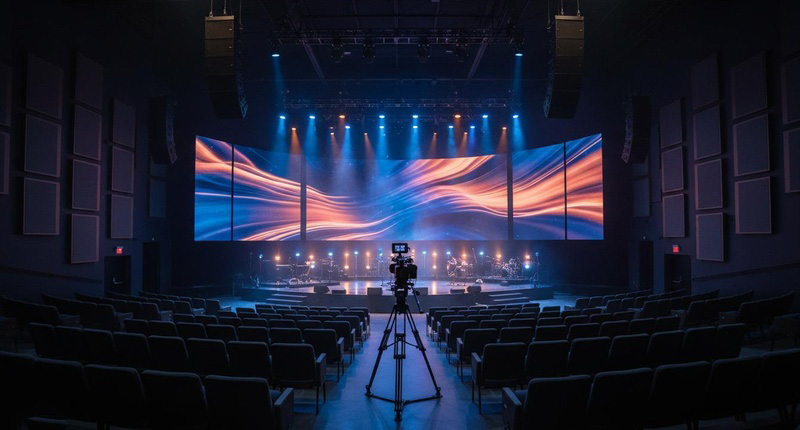
Die Migration von Projektion zu LED
| Faktor | Lampen-/Laserprojektion | LED-Videowand | Auswirkungen auf den Wiederverkäufer |
| Helligkeit | entspricht etwa 200–500 Nits | 800–1.500 cd/m² Innenbereich, einstellbar | LED setzt sich in Buntglas-Heiligtümern durch |
| Lebensdauer | 3.000–20.000 Stunden | 100.000 Stunden (10–15 Jahre) | Einmal verkaufen, minimalen Service bieten |
| Kontrast | Reflektiertes Licht, Grau, Schwarz | 3,000:1+ | Hervorragende Lesbarkeit der Liedtexte vor der Kamera |
| Flexibilität | Festes Projektionsverhältnis, Linsenbegrenzungen | Modular; beliebiges Seitenverhältnis oder Kurve | Passt sowohl für historische Kirchenschiffe als auch für moderne Bühnen |
| 5-Jahres-Wartungskosten | 8.000–15.000 (Lampen, Arbeitskräfte) | ~$1,500 (nur Ersatzmodule) | Geringe Wartungskosten in den späteren Phasen |
| Livestream | Scanzeilenartefakte | 3.840–7.680 Hz, kamerasicher | Unverzichtbar für hybride Gottesdienste |
Der Verkauf an mehrere Interessengruppen
Was Kirchenverträge so knifflig macht: Man verkauft nicht an nur einen Entscheidungsträger. Der Pastor möchte, dass alles einen guten Eindruck macht. Der ehrenamtliche Techniker – meist derjenige, der sonntagmorgens ProPresenter bedient – achtet auf die Bildwiederholfrequenz und darauf, ob die Bedienung intuitiv ist. Und der Finanzausschuss will verstehen, warum das mehr kostet als ein Beamer. Alle drei müssen zustimmen.
2022 lieferten wir eine P2.9 5×3 m große Projektionswand an eine 400 Plätze fassende Gemeinde der Assemblies of God in einem Vorort von Dallas. Der Pastor war von der Vorführung begeistert. Der ehrenamtliche Technikchef fand die NovaStar-Benutzeroberfläche ansprechend. Doch der Abschluss verzögerte sich um vier Monate, da der Schatzmeister die Gesamtkosten von 62.000 Dollar nicht mit einem Angebot von 4.000 Dollar für einen neuen Projektor in Einklang bringen konnte – bis unser Vertriebspartner ihm die Wartungskosten über zehn Jahre hinweg erläuterte. Die Lehre daraus: Zuerst den Technikchef überzeugen (er wird sich intern dafür einsetzen), dann dem Finanzausschuss eine detaillierte Aufstellung der Wartungskosten vorlegen, bevor dieser danach fragt.
Über diesen Leitfaden
Bei der Suche nach “LED-Bildschirmdimensionierung für Kirchen” finden Sie zahlreiche Checklisten für Pastoren. Dieser Leitfaden richtet sich an Händler und Systemintegratoren – aus Herstellersicht – und behandelt die Geometrie von Kirchenräumen, Pixelabstandsberechnungen, Stromversorgungs- und Statikanforderungen sowie Content-Workflows.
Kirchenräume verstehen: Einheitslösungen passen nicht für alle
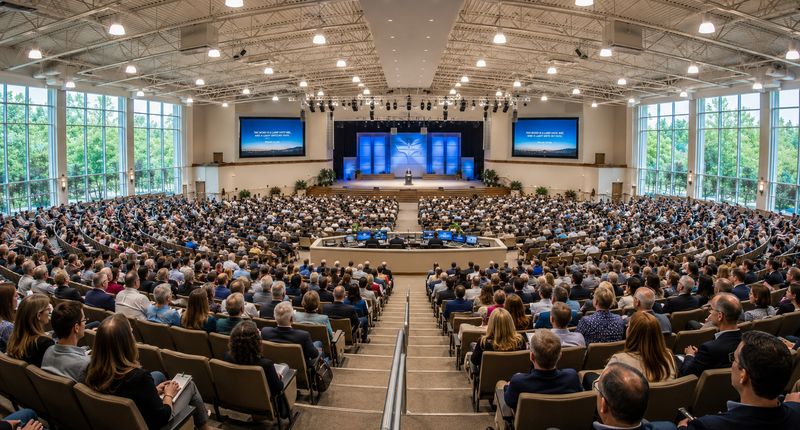
Der teuerste Fehler, den Wiederverkäufer begehen, ist, beim ersten Anruf für jede Kirche identische Paneelspezifikationen anzugeben. traditionelles Gotteshaus mit 500 Sitzplätzen mit Buntglasfenstern erfordert ein grundlegend anderes Produkt als ein modernes Auditorium mit 500 Sitzplätzen mit Verdunkelungsvorhängen und einem Sendestudio.
Vier Raumtypen dominieren die LED-Landschaft in nordamerikanischen und europäischen Gotteshäusern:
| Merkmal | Traditionelles Heiligtum | Modernes Auditorium | Gemeindesaal / Mehrzweckraum | Veranstaltungsort im Freien |
| Architektur | Hohe Gewölbedecken, fächerförmige Kirchenbänke, Buntglasfenster, möglicher Balkon in 20-30 m Höhe | Bühnenorientiertes Design, Theaterbeleuchtung, Verdunkelungsmöglichkeit, Laufstege | Flache Decke, bewegliche Möbel, nicht AV-optimiertes Layout | Rasenfläche, Parkplatz oder provisorische Bühne; kein Unterstand |
| Größte Sichtweite | 25-50 m (Balkon hinten) | 15-30 m (hintere Reihe) | 8-15 m | 20-60 m (Menschentiefe) |
| Herausforderung Umgebungslicht | 2.000–5.000 Lux durch Buntglas; je nach Jahreszeit und Tageszeit unterschiedlich | Vollständig steuerbar; 100–300 Lux im Betrieb | Leuchtstoffröhren an der Decke in Kombination mit Tageslicht; 500–2000 Lux | Direkte Sonneneinstrahlung; 10.000–100.000 Lux |
| Hauptinhalt | Schrifttext, liturgische Folien, gelegentlich Videos | IMAG-Kamerabild, Livestream, animierte Hintergründe, Umschaltung zwischen mehreren Quellen | Ankündigungen, Videowiedergabe, Simultanübertragung bei Überlauf | Taufen, Gemeindeveranstaltungen, Ostersonnenaufgang |
| Empfohlener Pixelabstand | P2.9-P3.9 | P2.6-P2.9 (Hauptbildschirm); P2.9-P3.9 (Seitenbildschirme) | P2.9-P3.9 | P3,9-P4,8 (Bühne); P4,8-P6,67 (Zuschauerfernfeld) |
| Helligkeitsanforderung | 1.500–2.500 Nits zur Überwindung der Blendwirkung von Buntglas | 600-1.200 Nits (kamerafreundlich in dunklen Räumen) | 1.000-1.500 Nits | 5.000-8.000+ Nits |
| Aktualisierungsrate | Mindestfrequenz 3840 Hz (häufig bei Beerdigungen/Hochzeiten aufgenommen) | 7.680 Hz bei Livestream; 3.840 Hz akzeptabel, wenn keine Übertragung | 1920–3840 Hz | Mindestens 3.840 Hz |
| Strukturelle Realität | Putz-/Betonwände sind möglicherweise nicht tragfähig; Genehmigung des Kirchenvorstands erforderlich. | Vorgefertigte Befestigungspunkte serienmäßig; einfache Wand- oder Traversenmontage | Keine Montage erforderlich; nur Bodenaufstellung; muss zwischen den Einsätzen eingelagert werden. | Maßgefertigter Ballastrahmen oder Bühnentraversen; Windlast kritisch |
| Installationstyp | Feste Wandmontage mit Wartungszugang an der Vorderseite | Fest installiert; Wandmontage oder hängend | Modulare Schnellkupplung an rollbaren Bodenstapelrahmen | Einsatz im Mietkoffer-Stil; IP65 erforderlich |
| Typisches LED-Budget | 35,000-85,000 | 50.000-150.000+ (Hauptbildschirme + Seitenbildschirme) | 15,000-35,000 | 20.000–60.000 (Haltbarkeit in Mietqualität) |
Raumfahrtspezifische technische Überlegungen
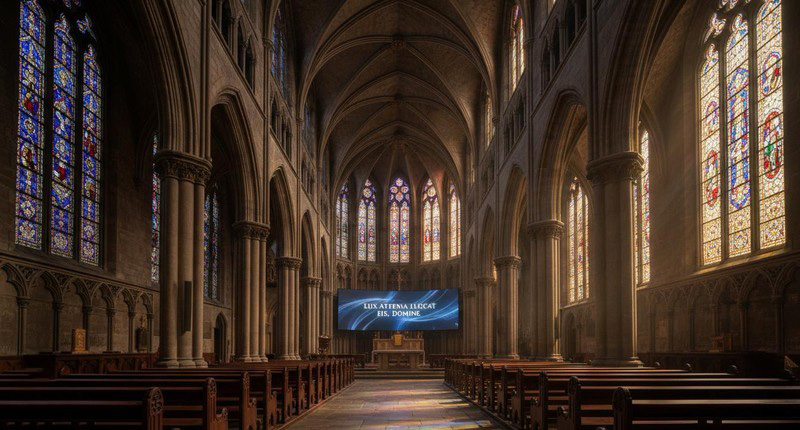
Traditionell church present a dual challenge: brightness and viewing angle. Specifying a 600-nit panel for a Gothic Revival sanctuary with eastern-facing stained glass produces a gray rectangle every Sunday from March through September. These environments demand 1,500–2,500 nits. At the same time, fan-shaped seating with side pews can push attendees beyond 140 degrees off-axis. Standard panels drop color accuracy past 120 degrees; sites with occupied side pews past 140 degrees require wide-viewing-angle SMD packages (160-degree horizontal minimum).
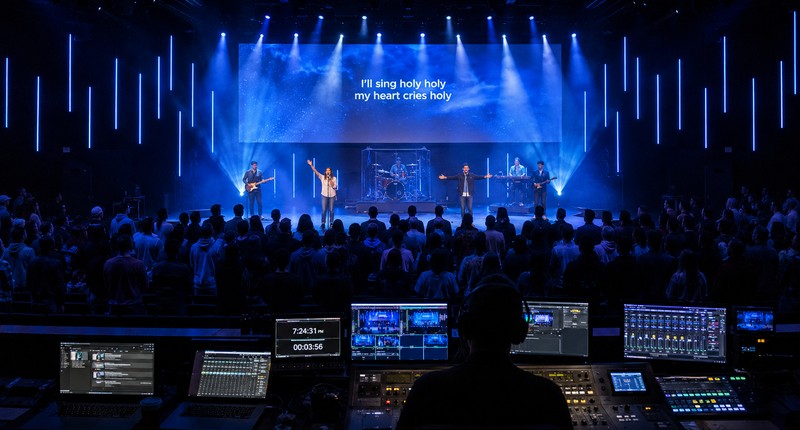
Modern auditoriums demand high refresh rates for broadcast. Any church running a livestream requires Mindestens 3.840 Hz—at 1,920 Hz, rolling band artifacts appear unpredictably depending on camera shutter phase. Churches with dedicated broadcast suites or multi-campus simulcast benefit from 7,680 Hz panels.
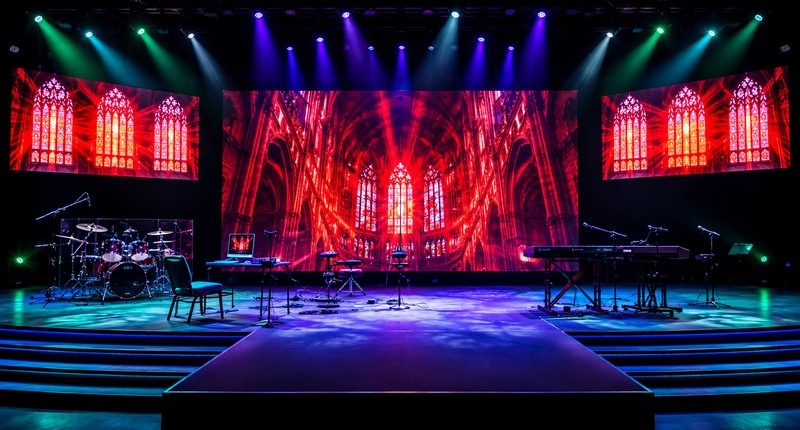
Fellowship halls favor modular ground-stack systems. A volunteer-friendly frame with tool-free latching allows a two-person team to set up or strike the wall in under 20 minutes. Quick-disconnect power and data cabling, packaged in two or three flight cases, stores in a standard supply closet.
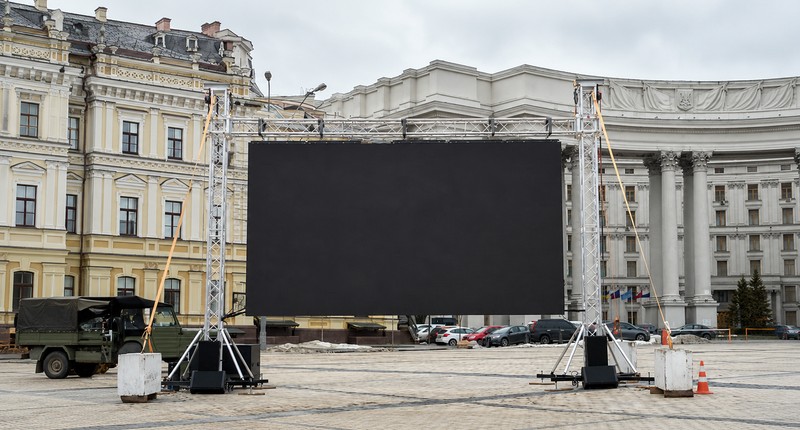
Outdoor venues require IP65 cabinet sealing Und 5,000+ nits for daylight readability—driving heat generation 20–30% over indoor panels and demands active thermal management. Seasonal deployments benefit from rental-grade flight-case packaging with modular 500 × 500 mm oder 500 × 1000 mm cabinets that scale to crowd size.
Checkliste zur Raumdiagnose: Fünf Fragen, die jeder Wiederverkäufer beim ersten Kontakt stellen muss
Resellers with the lowest return rate and highest referral rate in our distributor network run through the same questions on every first discovery call. It takes under three minutes and prevents the majority of mis-specification callbacks:
● “What is the furthest seated viewing distance?” Determines pixel pitch and minimum screen height (distance ÷ 6 to 8).
● “Do you livestream, record, or use IMAG camera projection?” Quote 3,840 Hz minimum; upsell 7,680 Hz for any broadcast ambition.
● “Describe your room lighting: stained glass windows, skylights, or full blackout capability?” Eliminates ~70% of mis-specified brightness callbacks.
● “Who operates your AV system on Sunday mornings—paid staff or volunteers?” Volunteer-run sites need simpler control workflows and more forgiving failure modes.
● “Is this a permanent installation, or do you need flexibility to move or resize the screen?” Shifts the product category from fixed-install cabinets to modular rental-grade frames.
Leitfaden zur Dimensionierung von LED-Bildschirmen in Kirchen: So berechnen Sie die richtige Wandgröße
Formeln zur Berechnung der Sichtweite
Every sizing conversation starts with two measurements: distance to the front row (closest viewer) and to the back row or balcony (farthest viewer).
1. Minimum viewing distance (m) = Pixel pitch (mm) × 1. A P2.9 panel requires at least 2.9 m (~9.5 ft); closer than that, individual LEDs become visible.
2. Optimal viewing distance (m) = Pixel pitch (mm) × 3. That same P2.9 panel looks sharpest at roughly 8.7 m (~28.5 ft).
3. Screen height = farthest viewing distance ÷ 6 to 8. A church with a balcony 18 m from the stage needs a screen height of 2.25–3 m. Multiply height by 1.78 for 16:9 width, yielding roughly 4–5.3 m, then round to cabinet multiples.
Kirchenbetrachtungszonen und Pixelabstands-Kartierung
| Viewing Zone | Distance from Screen | Empfohlener Pixelabstand | Typical Application |
| Front row | 3–5 m (10–16 ft) | P1.9–P2.6 | Stage backdrop, small chapel main screen |
| Mid section | 8–15 m (26–49 ft) | P2.6–P3.9 | Medium sanctuary primary display |
| Balcony / rear | 15–30 m (49–98 ft) | P3.9–P4.8 | Large auditorium main wall, IMAG screens |
Das Problem der ersten Sitzreihe
In a 150-seat chapel where the first pew sits 3 m from the stage, P2.9 appears grainy to close viewers. P1.9 or P2.5 is the safer spec there. Conversely, a 600-seat auditorium with the nearest viewer 10 m away gains nothing from P1.9—the extra resolution is invisible at that distance, while per-cabinet cost jumps 40–60%.
Kabinettsmathematik
Indoor church panels are manufactured on two die-cast aluminum cabinet form factors: 500 × 500 mm Und 500 × 1000 mm. Final wall dimensions must be integer multiples of 500 mm.
● 5 m × 3 m using 500 × 500 mm: 10 wide × 6 high = 60 cabinets (exact match)
● 4.5 m × 2.5 m: 9 wide × 5 high = 45 cabinets (exact match)
● 4.8 m × 2.7 m: Not divisible by 0.5 m—round down to 4.5 m × 2.5 m or up to 5 m × 3 m, We recommend rounding up and framing it as “future-proofing room for content expansion.”
Seitenverhältnis
16:9 is the default for roughly 85% of sanctuaries—it matches ProPresenter, camera feeds, and lyric software without letterboxing.
21:9 (ultra-wide) suits broad contemporary stages where the church wants lyrics on one side and motion backgrounds on the other. The trade-off is workflow complexity: it requires either 21:9 native content or dual-zone processing, which most volunteer operators can’t manage without additional training.
Custom ratios sometimes emerge from architectural constraints. Unless the church has a full-time media director with After Effects experience, steer them back to 16:9—non-standard ratios add content-creation friction that strains the volunteer team and, eventually, erodes your referral relationship with that church.
Helligkeitsanpassung
For controlled indoor lighting—the majority of churches—800–1,500 nits is correct. Sanctuaries with stained glass, skylights, or south-facing windows need 1,500–2,500 nits. Anything beyond 2,500 nits indoors inflates hardware cost and power consumption, and in a dim worship environment it causes eye fatigue, washes out IMAG skin tones, and overexposes camera feeds.
Panels with auto-dimming (10–100% range) typically run at 50–70% of maximum brightness during services. That reduces power draw by 20–30% and extends LED lifespan toward 80,000+ hours from the 60,000-hour baseline. Inform the customer – lower electricity bills and a longer replacement cycle that they will know how to choose.
Auswahl des Pixelabstands: Die Spezifikation, die über Erfolg oder Misserfolg beim Verkauf entscheidet
Pixel pitch determines whether front-row donors see a seamless image or a grid of glowing dots, and it drives 60-70% of total hardware cost. This is the conversation that matters.
Die drei Stufen des Pixelabstands für LED-Videowände in Kirchen
| Tier | Pitch | Beste Betrachtungsentfernung | Typical Application | Price vs. P3.9 |
| Premium | P1.9 – P2.6 | 2 – 8 ft | Front-row sanctuaries under 5 m, broadcast studios | 1.5 – 2.0× |
| Sweet spot | P2.9 – P3.9 | 8 – 15 ft | Main sanctuary backdrop; P2.9 for 5-8 m, P3.9 for 8-15 m | 1.0× (baseline) |
| Budget | P4.8 – P6.25 | 12 – 25 ft | Rear walls, side IMAG, overflow rooms | 0.6 – 0.8× |
The premium tier serves churches where the front row sits under 5 m from the stage. At that distance, P3.9 reveals individual pixels. P1.9 costs 1.5-2× what P2.9 does, yet the difference is invisible past row five. We advise spec’ing P2.6 for center stage and redirecting savings into refresh rate or controller redundancy. The audience will notice scan lines on a livestream before they notice the difference between P1.9 and P2.6 from row ten.
The sweet spot tier accounts for roughly 80% of sanctuary display projects we manufacture. P2.9 is the default for mid-size church— its 8.7 ft minimum viewing distance covers the first several pews. P3.9 sits at roughly 20% below P2.9, ideal where the front row starts at 10 ft or more. An LED video wall for churches in this tier balances cost and clarity for the overwhelming majority of congregations.
The budget tier fills a narrow niche. P4.8 works for balcony-facing screens or deep rear walls with viewers 15 m back, but we do not recommend it for main stage backdrops when the front row is within 12 ft. At that proximity, worshippers see pixel structure and lyric text loses readability. I have seen P4.8 spec’d for a main stage where the front row was 8 ft away. The pastor called after the first service to say the lyrics looked “like a crossword puzzle.”
Wie man einem Pastor die Pixelabstufung erklärt
Resellers who lead with spec sheets consistently lose the room in church environments. The pastor does not care about 2.9 mm — what they care about is whether it looks sharp to the congregation.
Experienced resellers in this space recommend reframing the conversation around viewer experience rather than technical specifications. Instead of quoting pixel pitch numbers, describe what the audience sees: from the third row back, no individual pixels are visible; from the front row, the image looks as sharp as a television.
For pricing conversations, framing the cost difference as a stewardship issue tends to be effective — the front rows are where major donors sit, and a grainy image at close range sends an unintended message about quality.
One practical recommendation from multiple distributors: bring both P2.9 and P3.9 sample modules to the sanctuary and let the pastor compare them from the front pew. Seeing the difference firsthand eliminates the abstract-spec discussion entirely
Bildwiederholfrequenz: Die versteckte Spezifikation, die Livestreams ruiniert
Refresh rate is the spec factories bury when it is low, and the single most common cause of livestream complaints. A panel at 1,920 Hz looks fine to the human eye, but point a camera at it and scan lines, moiré, and rolling bands appear immediately.
If a church livestreams even once a month, 3,840 Hz is the minimum. Below that threshold, every camera angle captures scan-line artifacts, moiré, and rolling bands that post-production cannot remove. Multi-camera IMAG setups with professional switchers benefit from 7,680 Hz, which also future-proofs against camera upgrades over the next five to seven years.
Budget panels from second-tier factories frequently ship at 1,920 Hz marketed as “HD refresh.” Get written confirmation from the factory, stating the guaranteed refresh rate at standard brightness.
Installationsrealitäten: Was Sie vor der Angebotserstellung prüfen sollten
Most U.S. and European churches were built between 1920 and 1960, long before anyone imagined hanging a half-ton electronic display inside them. The majority of post-installation problems trace back to details resellers never verified during quoting.
Auswahl der Montageart
Three mounting approaches dominate church installations. Your choice should follow a simple logic: what will the building allow, what will the client spend, and how permanent is this? Lead every site survey with a wall tap test and a conversation with the facilities manager about construction date and wall material.
| Mounting Method | Structure Required | Capacity Needed | Hardware Spec | Relative Cost |
| Wall-mounted | Concrete/reinforced masonry | ≥150 kg/m² | M10–M12 bolts, 40–50 cm spacing | Low |
| Ground-stacked | Level floor + rear access | Floor ≥50 kg/m² | Base plate + rear support truss | Medium |
| Flown/truss-hung | Engineer-rated ceiling | 200–300 kg/m² | Aircraft-grade cable 5,000+ lbs | Hoch |
Wall-mounted is the default. The wall must be load-bearing concrete or reinforced masonry rated for ≥150 kg/m², with M10–M12 expansion bolts at 40–50 cm spacing set with epoxy resin. Drywall cracks under 100 kg/m² and fails catastrophically under 400+ kg—stud walls require a steel backing plate.
Ground-stacked requires no wall dependency, installs in hours, and allows relocation. A 5 m × 3 m stack needs roughly 6 m × 4 m of floor area including truss footprint. The most volunteer-friendly option.
Flown or truss-hung requires a ceiling rated for 200–300 kg/m² Und aircraft-grade rigging cable (5,000 lbs / 2,268 kg minimum). Requires structural engineer sign-off in virtually every jurisdiction, adding $3,000–$8,000 that resellers routinely forget to budget.
If wall capacity is borderline, recommend ground-stack or flown rather than gambling on marginal support. “It should be fine” is not an engineering assessment. Get it in writing from a structural engineer or choose a different mounting method.
Energieinfrastruktur
More church LED projects hit trouble here than any other area. Those 1950s electrical systems were designed for incandescent lighting and a coffee maker, not a 5–8 kW display wall.
Average power draw runs 200–350 W/m² under normal content. Peak draw, during all-white calibration or maximum brightness, reaches 580–700 W/m². A 12 m² display at peak pulls roughly 7.0–8.4 kW. At 120V North American service, that is 58–70 amps. Even at 230V EU service, you need 30–36 amps.
| Anzeigegröße | Average Draw | Peak Draw | 120V Circuits (20A) | 230V Circuits (16A) |
| 5 m² | 1,400 W | 3,250 W | 1 dedicated | 1 dedicated |
| 10 m² | 2,800 W | 6,500 W | 2 dedicated | 1 dedicated |
| 15 m² | 4,200 W | 9,750 W | 3 dedicated | 2 dedicated |
| 20 m² | 5,600 W | 13,000 W | 4 dedicated | 3 dedicated |
Any display over 8 m² needs two dedicated 20A circuits at 120V with no shared loads. Churches built before 1970 may need a sub-panel upgrade. Always bring an electrician on the site survey and scope electrical work as a separate line item—not as a surprise that surfaces after the quote is signed.
Thermal management: LED cabinets need a 100–150 mm air gap behind the wall for heat dissipation. Internal temperatures above 60°C reduce LED lifespan by roughly 30% and cause visible color shift. Fanless designs are preferable for sanctuaries—fans become audible during quiet sermon moments, and that’s a complaint no church will tolerate quietly.
Signal- und Steuerungssysteme
The signal path in a typical church runs 10–30 m from the FOH media booth to the LED wall. The controller sits at the wall, not at the source, so plan the cable run during quoting.
| Controller | Input Ports | Max Resolution | Am besten geeignet für | Cost Tier |
| NovaStar VX4S | HDMI 2.0, DVI, SDI | 4K | Mainstream church walls up to 8K pixels wide | Value |
| NovaStar MCTRL R5 | 8× Ethernet + 2× fiber | Large walls | Wide walls requiring fiber extension | Mid-range |
| Brompton Tessera | SDI, HDMI | 4K | Broadcast-grade HDR live TV production | Premium |
Manufacturers default to NovaStar: the VX4S handles 95% of church applications. The MCTRL R5 is needed when cable runs exceed 100 m or pixel width exceeds a single VX4S. Brompton processors excel for broadcast-level IMAG at 3–4× the NovaStar price.
Akustische Überlegungen
LED cabinets—especially ground-stacked on hollow wood platforms—resonate at 60–120 Hz. When the PA pushes low-end through subwoofers, vibration couples into cabinet frames, producing a hum audible during quiet prayer and through lectern mics.
The fix is straightforward but must be planned at installation: rubber vibration isolation pads between the bottom row of cabinets and the floor, with a solid plywood base board under the pads to distribute load and damp resonance. For wall-mounted installs, rubber washers at every bolt point break the vibration transmission path.
Freiwilligenschulung: Der Schlüssel zur langfristigen Zufriedenheit
Deliver three tools for volunteer-operated sites:
● Laminated SOP checklist: power-on sequence, source selection, brightness preset, and critical power-off order (signal off first, then controller, then wall).
● 5-minute operation video QR-coded to the cabinet door.
● Troubleshooting card covering the top five issues (no signal, wrong input, color shift, frozen frame, audio sync) with one-step fixes.
Based on feedback from our North American distributors, churches that receive a structured 30-minute onboarding session report substantially fewer support calls in the first year. That half-hour is the most cost-effective investment in the entire project
Budgetierung und Preisgestaltung
Von den Fabrikkosten bis zum Kirchenangebot
The factory EXW Shenzhen pricing for P2.5–P3.9 indoor panels runs $300–$500 per m². But landed US cost adds 25% Section 301 tariff, sea freight ($800–$2,500 per pallet), and customs clearance — pushing true acquisition cost 35–50% above EXW before you store or test a single cabinet.
| Cost Tier | Markup over Landed | Church Price per m² | What Is Included |
| Competitive (volume play) | 40–70% | $750–$1,200 | Panels, controller, basic mounting, remote support |
| Standard (full-service) | 80–150% | $1,200–$2,000 | Above + structural review, install labor, calibration, training, 2–3 yr warranty |
| Premium (brand integrator) | 100–200%+ | $2,000–$3,500+ | Above + custom content, acoustic integration, project manager, 5-yr advance-replacement warranty |
A proper turn-key quote bundles seven line items: panels, video controller/processor, mounting hardware, structural engineering, installation labor, calibration and training, and warranty with spare parts. Factory quotes typically cover only item one; accessories add 20–40% to real cost.
Typische Projektbudgetbereiche
| Church Size | Seating | Wall Area | Church-Facing Price |
| Small chapel | Under 300 | 6–12 m² | $15,000–$40,000 |
| Medium sanctuary | 300–800 | 12–30 m² | $40,000–$100,000 |
| Large auditorium | 800+ | 30–80+ m² | $100,000–$300,000+ |
When it comes to screen sizing, cost scales directly with display area. Small churches at $15,000 buy a single P3.9 stage wall for lyric visibility. At $100,000+, medium churches add IMAG side-fills and broadcast-grade refresh rates. Large installs above $200,000 involve custom aspect ratios, curved configurations, and broadcast infrastructure integration.
Versteckte Kosten, die frühzeitig erkannt werden sollten
Structural engineering: reinforcing a 1920s masonry wall or adding steel behind drywall costs $5,000–$15,000+, and the 1.5× safety factor means a 400 kg wall needs 600 kg-rated mounting.
Electrical upgrades: a 12 m² wall at peak draw needs two dedicated 20A circuits; older sanctuaries often need panel upgrades — budget $3,000–$10,000.
Acoustic treatment: LED cabinets reflect sound differently than fabric backdrops, and hard stage surfaces create slap echo requiring added absorption.
Training: even plug-and-play systems need a half-day on-site session; factor travel and labor into every quote or your client blames the product for volunteer errors. One afternoon of training would have prevented six months of support calls.
Sechs Fehler, die Wiederverkäufer ihren Job in der Kirche kosten
#1: Die Frage “Wie groß soll die Leinwand sein?” ohne zu fragen “Wo steht der Pastor?”
Pulpit position determines sightlines, mounting height, and whether the bottom row of cabinets sits above the congregation’s sightline or behind the choir riser. A screen sized purely by auditorium square footage can end up blocked by a centrally placed baptismal font. Always ask for a stage floor plan before you lock cabinet count, and we need it before I quote.
#2: Ein 120 Jahre altes Schutzgebiet wie einen kommerziellen Konferenzraum behandeln
Historic preservation restrictions, non-load-bearing plaster walls, and stained glass that floods the room with 5,000 lux of ambient light make house of worship LED installation fundamentally different from corporate AV. A reseller who quotes drywall direct-mount hardware for a 1920s brick-and-lathe nave is asking for structural failure. Budget $5,000–$15,000 for structural engineering on any pre-1960 building, and specify 1,500–2,500 nits.
#3: Die Kirche soll durch freiwillige Arbeit “Geld sparen”.
Church volunteers can manage cable runs and flight-case assembly. They cannot calculate a 1.5× safety factor on a 500 kg wall-mounted array, route 240V dedicated circuits, or align a 10 × 6 cabinet grid to within 0.5 mm for seamless seams. Misaligned cabinets produce visible gaps that the church lives with for a decade. Insist on certified installation for any wall-mounted or flown configuration; let volunteers handle ground-stack setups only.
#4: Hardwareversand ohne Schulungsplan
Content tickets outnumber hardware failures three to one in the first six months. A church with ProPresenter, a NovaStar controller, and no trained volunteer is a church that will blame you for blurry lyrics. Bundle a 30-minute onboarding session, a laminated SOP card, and a 5-minute QR-code video. Churches that train volunteers report 70% fewer support calls in year one.
#5: Die zeitbombe Ersatzteile ignorieren
LED module die sets change every 18–24 months. A church that needs four replacement modules in year four discovers the factory discontinued that batch in year two. Color mismatch between old and new batches is visible from the balcony. Fix it at purchase: order 2–5% spare modules and one spare power supply up front, and get written confirmation from the factory of 3–5 year parts availability. The $800 spare-kit investment prevents a $35,000 “the wall looks patchy” crisis.
#6: Die Bildwiederholfrequenz wird nicht mit der tatsächlichen Kamera der Kirche getestet.
A spec sheet claiming 3,840 Hz is worthless if the pastor’s donated camcorder picks up scan lines at that shutter speed. Camera sensor phasing varies by model; what looks clean on your test bench may shimmer on their IMAG feed. Schedule a pre-install camera test with the church’s exact camera model and typical house lighting.
Beschaffung aus China: Was Wiederverkäufer ihren Hersteller fragen sollten
Was eine werksstandardmäßige Lieferung tatsächlich enthält
Verify your quote matches this bill of materials before you wire a deposit.
| Component | Spezifikation | Qty Basis |
| LED cabinets | 500×500mm or 500×1000mm die-cast aluminum | Per layout design |
| LED modules | 250×250mm magnetic front-access | 4 per 500×500 cabinet |
| Power supplies | Meanwell 5V 40A (200W), CE/FCC marked | 1 per 2-3 cabinets |
| Receiving cards | NovaStar A5s Plus-N, pre-installed | 1 per cabinet |
| Controller | NovaStar VX4S oder MCTRL R5 | 1 pro Wand |
| Signalkabel | Cat5e/Cat6 Reihenschaltung | Länge zum Layout |
| Stromkabel | IEC C13/C14, 14 AWG | Pro Stromplan |
| Montagezubehör | Wandhalterungen oder Stapelstangen | Auf Bestellung spezifiziert |
| Verpackung | Flightcases (Miete) oder Holzkiste (fest) | 6-8 Schränke pro Flightcase |
| Ersatzmodule | 2-5% der Gesamtzahl | 2-6 für mittelgroße Wände |
| Ersatznetzteile | 1-2 Einheiten | Hot-Swap-fähig |
| Ersatz-Empfangskarten | 1-2 Einheiten | Vorkonfiguriert |
| Werkzeugkasten | Magnetisches Extraktionswerkzeug, Ausrichtungslehren | 1 Stück pro Sendung |
Lieferzeiten und Logistikrealität
Planen Sie anhand dieser konkreten Zahlen vom Go-Live-Termin Ihres Kirchenkunden aus rückwärts.
| Phase | Dauer |
| Komponentenbeschaffung | 1-2 Wochen |
| Schrankmontage | 2-3 Wochen |
| Einbrenntest (72 Std.) | 3-5 Tage |
| Endkontrolle, Kalibrierung, Verpackung | 2-3 Tage |
| Gesamtproduktion | 4-8 Wochen |
| Seefracht zur US-Westküste | 18-25 Tage |
| Seefracht zur US-Ostküste | 30-40 Tage |
| Seefracht in die EU | 25-35 Tage |
| Zoll + Transport | 3-10 Tage |
| Gesamtvertrag bis zum Dock | 8-14 Wochen |
Luftfracht verkürzt die Transitzeit auf 5–7 Tage, kostet aber das 3–5-Fache des Seefrachtpreises ($8–15/kg). Sie ist nur bei Notfällen mit Ersatzmodulen gerechtfertigt; für komplette Wände selten.
US-Wiederverkäufer müssen einen zusätzlichen Zollsatz gemäß Abschnitt 301 25% auf chinesische LED-Module (HTS 8531.40) einplanen, der auf Basis des deklarierten Zollwerts berechnet wird.
Aufbau langfristiger Beziehungen zu Kirchen
Technologieentscheidungen in Kirchengemeinden ziehen sich in die Länge – von der ersten Angebotserstellung bis zur Bestellung vergehen 6 bis 18 Monate –, doch sobald Vertrauen aufgebaut ist, ist die Loyalität hoch. Gemeinden, die positive Erfahrungen gemacht haben, beauftragen uns erneut für die Ausstattung ihrer Eingangsbereiche, den Ausbau des Gemeindesaals oder den Bau von Außenstellen. Das Empfehlungsnetzwerk innerhalb der Kirchengemeinden ist außergewöhnlich aktiv: Ein erfolgreiches Projekt in einem Bezirk generiert im darauffolgenden Jahr zuverlässig zahlreiche weitere Anfragen.
Unser US-amerikanischer Vertriebspartner mit der längsten Geschäftsbeziehung begann 2019 mit der Installation in einer einzigen Baptistenkirche. Bis 2024 wurde diese Beziehung auf vier Standorte ausgeweitet, und der Vertriebspartner hat Installationen in zwölf weiteren Kirchen derselben Konfession abgeschlossen – allesamt ausgehend von diesem einen erfolgreichen Auftrag.
Die Wiederverkäufer, die in diesem Sektor erfolgreich sind, positionieren sich als Technologiepartner der Kirche – nicht nur als Lieferant von Bildschirmen. Das bedeutet, die Bildschirmwand korrekt zu dimensionieren, die Konstruktion zu überprüfen, die ehrenamtlichen Helfer zu schulen und am Sonntagmorgen erreichbar zu sein, wenn der Livestream startet. Pastoren erinnern sich eher an denjenigen, der ihr Problem um 7 Uhr morgens gelöst hat, als an denjenigen, der die billigsten Bildschirme geliefert hat. Dieser Ruf ist die Grundlage für die nächsten sechs Empfehlungen.
Starten Sie Ihr nächstes Kirchenprojekt
Die über 300.000 US-amerikanischen Kirchen sind kein Marktsegment, aus dem man einfach Profit schlagen und sich dann anderen Dingen zuwenden kann. Sie bilden ein Netzwerk, in dem sich Servicequalität stetig steigert – jedes erfolgreich abgeschlossene Projekt erleichtert den nächsten Verkauf und sorgt für die nächste Weiterempfehlung. Wir liefern seit über fünf Jahren Kirchen-Paneele aus, und das Muster ist immer gleich: Die Vertriebspartner, die Zeit in Standortanalysen, Schulungen und einen reaktionsschnellen Kundendienst investieren, sichern sich langfristige Kundenbeziehungen. Diejenigen, die es als einmaligen Verkauf betrachten, scheitern.