
Why churches are the next big market for LED resellers
If you haven’t quoted LED video walls to churches yet, you’re overlooking a steadily expanding segment. The U.S. has an estimated 300,000-plus houses of worship, and demand for LED displays in religious buildings has been climbing year over year—driven by livestreaming adoption, aging projector infrastructure, and congregations that now have AV teams comfortable with screen technology.
Most resellers we talk to still think churches are small-fry projector replacement jobs. They are not, the budget is real. Modest congregations allocate $15,000–$35,000 for sanctuary refreshes, while mid-size churches spend $30,000–$85,000 on a single LED package. I have seen a single well-executed church install turn into six referral jobs inside two years. Word travels fast in denomination circles.
Three things pushed this market open at roughly the same time. First, covid-era lockdowns forced nearly every church into livestreaming overnight—and once a camera is pointed at a projector screen in a sanctuary with stained-glass windows, the image falls apart: washed-out faces, scan-line artifacts, glare drowning out lyrics. Second, churches that upgraded their AV during lockdown now have volunteer tech teams who know how to operate screens and aren’t going back to projection. Third, laser projectors bought in 2017–2018 are hitting the six- or seven-year mark, and the typical church AV refresh cycle runs seven to ten years. That timing puts thousands of sanctuaries into the replacement window right now.
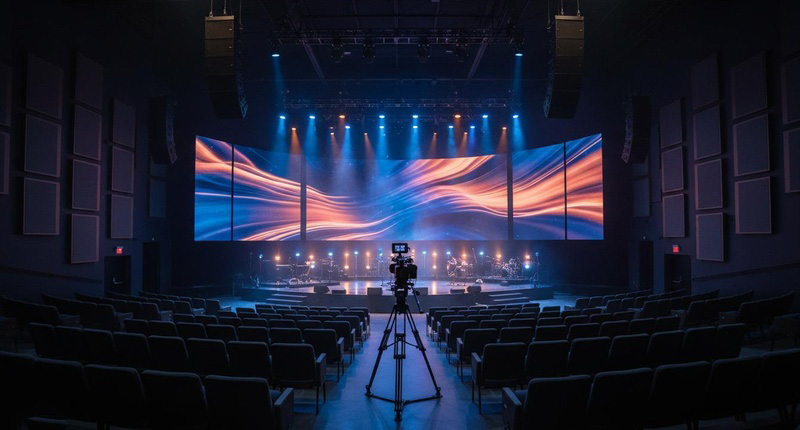
The projection-to-LED migration
| Factor | Lamp/Laser Projection | LED Video Wall | Reseller Implication |
| Brillo | ~200–500 nits equivalent | 800–1,500 nits indoor, adjustable | LED wins in stained-glass sanctuaries |
| Lifespan | 3,000–20,000 hours | 100,000 hours (10–15 years) | Sell once, service minimally |
| Contraste | Reflected-light gray blacks | 3,000:1+ | Superior lyric legibility on camera |
| Flexibilidad | Fixed throw ratio, lens limits | Modular; any aspect ratio or curve | Fits historic naves or modern stages |
| 5-Year Maintenance costs | 8,000–15,000 (lamps, labor) | ~$1,500 (spare modules only) | Low maintenance costs in the later stages |
| Livestream | Scan-line artifacts | 3,840–7,680 Hz, camera-safe | Essential for hybrid worship |
The multi-stakeholder sale
What makes church deals tricky: you aren’t selling to one decision-maker. The pastor wants it to look impressive. The volunteer tech operator—typically the person running ProPresenter on Sunday mornings—cares about refresh rate and whether the control workflow makes sense. And the finance committee wants to understand why this costs more than a projector. All three need to say yes.
In 2022, we shipped a P2.9 5×3 m wall to a 400-seat Assembly of God church in suburban Dallas. The pastor loved the demo. The volunteer tech director liked the NovaStar interface. But the deal stalled for four months because the treasurer couldn’t reconcile the 62,000 total against a 4,000 projector replacement quote—until our distributor walked him through the 10-year maintenance cost comparison. The lesson: win the tech operator first (they’ll advocate internally), then prepare a maintenance-cost breakdown for the finance committee before they ask for it.
About This Guide
Search “church LED screen sizing” and you’ll find plenty of checklists aimed at end-user pastors. This guide is written for resellers and integrators—from the factory perspective—covering sanctuary geometries, pixel-pitch calculations, power and structural requirements, and content workflows.
Understanding church spaces: one size does not fit all
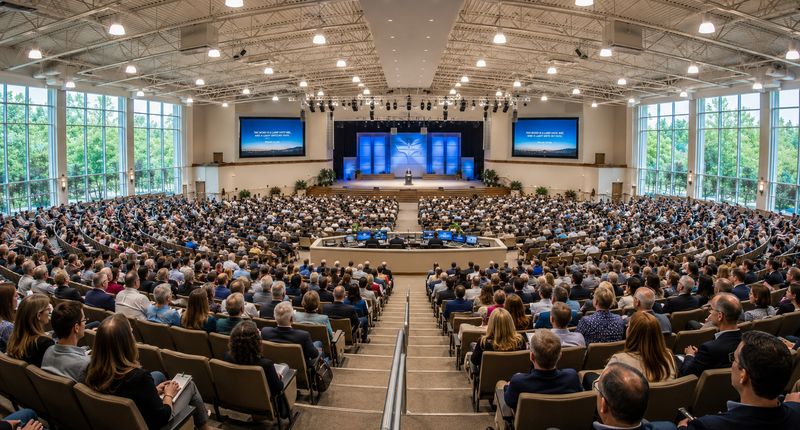
The most expensive mistake resellers make is quoting identical panel specifications for every church on the first call. A 500-seat traditional sanctuary with stained-glass windows demands a fundamentally different product than a 500-seat modern auditorium with blackout curtains and a broadcast suite.
Four space types dominate the North American and European house-of-worship LED landscape:
| Characteristic | Traditional Sanctuary | Modern Auditorium | Fellowship Hall / Multi-Purpose Room | Outdoor Venue |
| Architecture | High vaulted ceilings, fan-shaped pews, stained glass, possible balcony at 20-30 m | Stage-forward design, theatrical lighting, blackout capability, catwalks | Flat ceiling, movable furniture, non-AV-optimized layout | Lawn, parking lot, or temporary stage; no shelter |
| Furthest Viewing Distance | 25-50 m (balcony rear) | 15-30 m (rear row) | 8-15 m | 20-60 m (crowd depth) |
| Ambient Light Challenge | 2,000-5,000 lux from stained glass; variable by season and time of day | Fully controllable; 100-300 lux during service | Fluorescent overhead mixed with window light; 500-2,000 lux | Direct sunlight; 10,000-100,000 lux |
| Primary Content | Scripture text, liturgical slides, occasional video | IMAG camera feed, livestream, motion backgrounds, multi-source switching | Announcements, video playback, overflow simulcast | Baptisms, community events, Easter sunrise |
| Recommended Pixel Pitch | P2.9-P3.9 | P2.6-P2.9 (main); P2.9-P3.9 (side screens) | P2.9-P3.9 | P3.9-P4.8 (stage); P4.8-P6.67 (audience far field) |
| Brightness Requirement | 1,500-2,500 nits to overcome stained glass glare | 600-1,200 nits (camera-friendly in dark room) | 1,000-1,500 nits | 5,000-8,000+ nits |
| Frecuencia de actualización | 3,840 Hz minimum (funerals/weddings often recorded) | 7,680 Hz if livestreamed; 3,840 Hz acceptable if no broadcast | 1,920-3,840 Hz | 3,840 Hz minimum |
| Structural Reality | Plaster/concrete walls may not bear load; church board approval needed | Engineered rigging points standard; easy wall or truss mount | No rigging; ground-stack only; must store between uses | Custom ballast frame or stage truss; wind load critical |
| Installation Type | Permanent wall-mount with front service access | Permanent; wall-mount or flown | Modular quick-disconnect on rolling ground-stack frames | Rental-style flight-case deployment; IP65 required |
| Typical LED Budget | 35,000-85,000 | 50,000-150,000+ (main + side screens) | 15,000-35,000 | 20,000-60,000 (rental-grade durability) |
Space-Specific Engineering Considerations
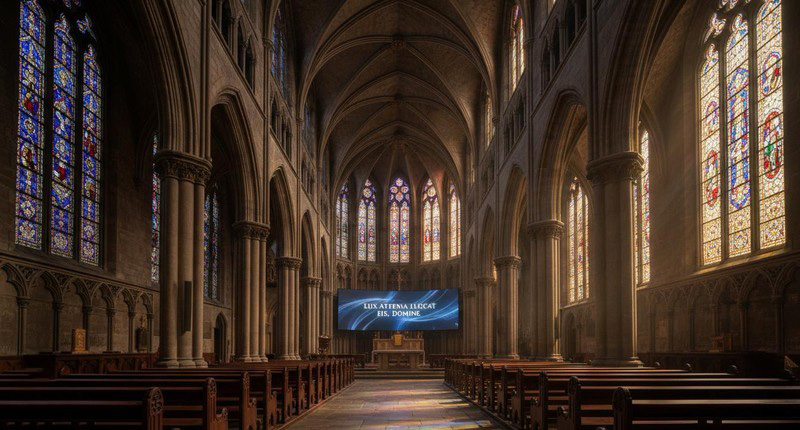
Traditional church present a dual challenge: brightness and viewing angle. Specifying a 600-nit panel for a Gothic Revival sanctuary with eastern-facing stained glass produces a gray rectangle every Sunday from March through September. These environments demand 1,500–2,500 nits. At the same time, fan-shaped seating with side pews can push attendees beyond 140 degrees off-axis. Standard panels drop color accuracy past 120 degrees; sites with occupied side pews past 140 degrees require wide-viewing-angle SMD packages (160-degree horizontal minimum).
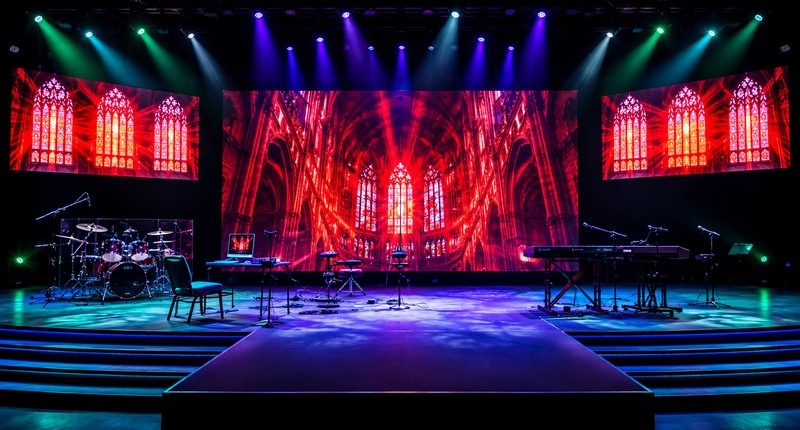
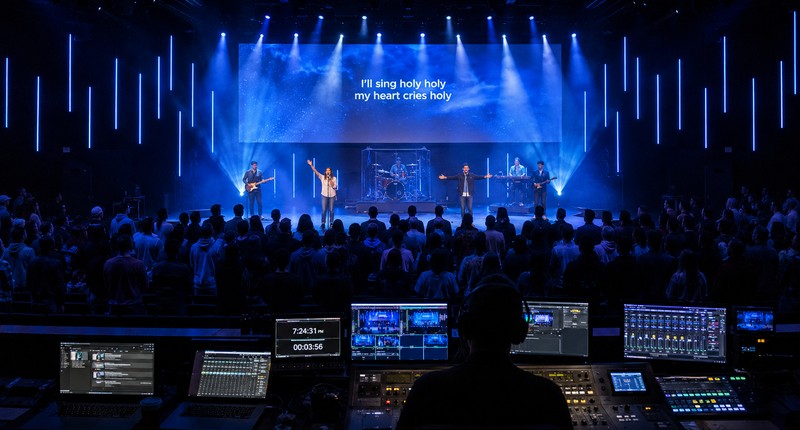
Modern auditoriums demand high refresh rates for broadcast. Any church running a livestream requires 3,840 Hz minimum—at 1,920 Hz, rolling band artifacts appear unpredictably depending on camera shutter phase. Churches with dedicated broadcast suites or multi-campus simulcast benefit from 7,680 Hz panels.
Fellowship halls favor modular ground-stack systems. A volunteer-friendly frame with tool-free latching allows a two-person team to set up or strike the wall in under 20 minutes. Quick-disconnect power and data cabling, packaged in two or three flight cases, stores in a standard supply closet.
Outdoor venues require IP65 cabinet sealing y 5,000+ nits for daylight readability—driving heat generation 20–30% over indoor panels and demands active thermal management. Seasonal deployments benefit from rental-grade flight-case packaging with modular 500 × 500 mm o 500 × 1000 mm cabinets that scale to crowd size.
Space diagnostic checklist: five questions every reseller must ask on first contact
Resellers with the lowest return rate and highest referral rate in our distributor network run through the same questions on every first discovery call. It takes under three minutes and prevents the majority of mis-specification callbacks:
● “What is the furthest seated viewing distance?” Determines pixel pitch and minimum screen height (distance ÷ 6 to 8).
● “Do you livestream, record, or use IMAG camera projection?” Quote 3,840 Hz minimum; upsell 7,680 Hz for any broadcast ambition.
● “Describe your room lighting: stained glass windows, skylights, or full blackout capability?” Eliminates ~70% of mis-specified brightness callbacks.
● “Who operates your AV system on Sunday mornings—paid staff or volunteers?” Volunteer-run sites need simpler control workflows and more forgiving failure modes.
● “Is this a permanent installation, or do you need flexibility to move or resize the screen?” Shifts the product category from fixed-install cabinets to modular rental-grade frames.
Church LED screen sizing guide: how to calculate the right wall
Viewing Distance Formulas
Every sizing conversation starts with two measurements: distance to the front row (closest viewer) and to the back row or balcony (farthest viewer).
1. Minimum viewing distance (m) = Pixel pitch (mm) × 1. A P2.9 panel requires at least 2.9 m (~9.5 ft); closer than that, individual LEDs become visible.
2. Optimal viewing distance (m) = Pixel pitch (mm) × 3. That same P2.9 panel looks sharpest at roughly 8.7 m (~28.5 ft).
3. Screen height = farthest viewing distance ÷ 6 to 8. A church with a balcony 18 m from the stage needs a screen height of 2.25–3 m. Multiply height by 1.78 for 16:9 width, yielding roughly 4–5.3 m, then round to cabinet multiples.
Church Viewing Zones and Pixel Pitch Mapping
| Viewing Zone | Distance from Screen | Recommended Pixel Pitch | Typical Application |
| Front row | 3–5 m (10–16 ft) | P1.9–P2.6 | Stage backdrop, small chapel main screen |
| Mid section | 8–15 m (26–49 ft) | P2.6–P3.9 | Medium sanctuary primary display |
| Balcony / rear | 15–30 m (49–98 ft) | P3.9–P4.8 | Large auditorium main wall, IMAG screens |
The Front-Row Problem
In a 150-seat chapel where the first pew sits 3 m from the stage, P2.9 appears grainy to close viewers. P1.9 or P2.5 is the safer spec there. Conversely, a 600-seat auditorium with the nearest viewer 10 m away gains nothing from P1.9—the extra resolution is invisible at that distance, while per-cabinet cost jumps 40–60%.
Cabinet Math
Indoor church panels are manufactured on two die-cast aluminum cabinet form factors: 500 × 500 mm y 500 × 1000 mm. Final wall dimensions must be integer multiples of 500 mm.
● 5 m × 3 m using 500 × 500 mm: 10 wide × 6 high = 60 cabinets (exact match)
● 4.5 m × 2.5 m: 9 wide × 5 high = 45 cabinets (exact match)
● 4.8 m × 2.7 m: Not divisible by 0.5 m—round down to 4.5 m × 2.5 m or up to 5 m × 3 m, We recommend rounding up and framing it as “future-proofing room for content expansion.”
Aspect Ratio
16:9 is the default for roughly 85% of sanctuaries—it matches ProPresenter, camera feeds, and lyric software without letterboxing.
21:9 (ultra-wide) suits broad contemporary stages where the church wants lyrics on one side and motion backgrounds on the other. The trade-off is workflow complexity: it requires either 21:9 native content or dual-zone processing, which most volunteer operators can’t manage without additional training.
Custom ratios sometimes emerge from architectural constraints. Unless the church has a full-time media director with After Effects experience, steer them back to 16:9—non-standard ratios add content-creation friction that strains the volunteer team and, eventually, erodes your referral relationship with that church.
Brightness Sizing
For controlled indoor lighting—the majority of churches—800–1,500 nits is correct. Sanctuaries with stained glass, skylights, or south-facing windows need 1,500–2,500 nits. Anything beyond 2,500 nits indoors inflates hardware cost and power consumption, and in a dim worship environment it causes eye fatigue, washes out IMAG skin tones, and overexposes camera feeds.
Panels with auto-dimming (10–100% range) typically run at 50–70% of maximum brightness during services. That reduces power draw by 20–30% and extends LED lifespan toward 80,000+ hours from the 60,000-hour baseline. Inform the customer – lower electricity bills and a longer replacement cycle that they will know how to choose.
Pixel pitch selection: the spec that makes or breaks the sale
Pixel pitch determines whether front-row donors see a seamless image or a grid of glowing dots, and it drives 60-70% of total hardware cost. This is the conversation that matters.
The three tiers of pixel pitch for church LED video walls
| Tier | Pitch | Mejor distancia de visualización | Typical Application | Price vs. P3.9 |
| Premium | P1.9 – P2.6 | 2 – 8 ft | Front-row sanctuaries under 5 m, broadcast studios | 1.5 – 2.0× |
| Sweet spot | P2.9 – P3.9 | 8 – 15 ft | Main sanctuary backdrop; P2.9 for 5-8 m, P3.9 for 8-15 m | 1.0× (baseline) |
| Budget | P4.8 – P6.25 | 12 – 25 ft | Rear walls, side IMAG, overflow rooms | 0.6 – 0.8× |
The premium tier serves churches where the front row sits under 5 m from the stage. At that distance, P3.9 reveals individual pixels. P1.9 costs 1.5-2× what P2.9 does, yet the difference is invisible past row five. We advise spec’ing P2.6 for center stage and redirecting savings into refresh rate or controller redundancy. The audience will notice scan lines on a livestream before they notice the difference between P1.9 and P2.6 from row ten.
The sweet spot tier accounts for roughly 80% of sanctuary display projects we manufacture. P2.9 is the default for mid-size church— its 8.7 ft minimum viewing distance covers the first several pews. P3.9 sits at roughly 20% below P2.9, ideal where the front row starts at 10 ft or more. An LED video wall for churches in this tier balances cost and clarity for the overwhelming majority of congregations.
The budget tier fills a narrow niche. P4.8 works for balcony-facing screens or deep rear walls with viewers 15 m back, but we do not recommend it for main stage backdrops when the front row is within 12 ft. At that proximity, worshippers see pixel structure and lyric text loses readability. I have seen P4.8 spec’d for a main stage where the front row was 8 ft away. The pastor called after the first service to say the lyrics looked “like a crossword puzzle.”
How to Explain Pixel Pitch to a Pastor
Resellers who lead with spec sheets consistently lose the room in church environments. The pastor does not care about 2.9 mm — what they care about is whether it looks sharp to the congregation.
Experienced resellers in this space recommend reframing the conversation around viewer experience rather than technical specifications. Instead of quoting pixel pitch numbers, describe what the audience sees: from the third row back, no individual pixels are visible; from the front row, the image looks as sharp as a television.
For pricing conversations, framing the cost difference as a stewardship issue tends to be effective — the front rows are where major donors sit, and a grainy image at close range sends an unintended message about quality.
One practical recommendation from multiple distributors: bring both P2.9 and P3.9 sample modules to the sanctuary and let the pastor compare them from the front pew. Seeing the difference firsthand eliminates the abstract-spec discussion entirely
Refresh Rate: The Hidden Spec That Kills Livestreams
Refresh rate is the spec factories bury when it is low, and the single most common cause of livestream complaints. A panel at 1,920 Hz looks fine to the human eye, but point a camera at it and scan lines, moiré, and rolling bands appear immediately.
If a church livestreams even once a month, 3,840 Hz is the minimum. Below that threshold, every camera angle captures scan-line artifacts, moiré, and rolling bands that post-production cannot remove. Multi-camera IMAG setups with professional switchers benefit from 7,680 Hz, which also future-proofs against camera upgrades over the next five to seven years.
Budget panels from second-tier factories frequently ship at 1,920 Hz marketed as “HD refresh.” Get written confirmation from the factory, stating the guaranteed refresh rate at standard brightness.
Installation Realities: What to Check Before Quoting
Most U.S. and European churches were built between 1920 and 1960, long before anyone imagined hanging a half-ton electronic display inside them. The majority of post-installation problems trace back to details resellers never verified during quoting.
Mounting Method Selection
Three mounting approaches dominate church installations. Your choice should follow a simple logic: what will the building allow, what will the client spend, and how permanent is this? Lead every site survey with a wall tap test and a conversation with the facilities manager about construction date and wall material.
| Mounting Method | Structure Required | Capacity Needed | Hardware Spec | Relative Cost |
| Wall-mounted | Concrete/reinforced masonry | ≥150 kg/m² | M10–M12 bolts, 40–50 cm spacing | Low |
| Ground-stacked | Level floor + rear access | Floor ≥50 kg/m² | Base plate + rear support truss | Medio |
| Flown/truss-hung | Engineer-rated ceiling | 200–300 kg/m² | Aircraft-grade cable 5,000+ lbs | High |
Wall-mounted is the default. The wall must be load-bearing concrete or reinforced masonry rated for ≥150 kg/m², with M10–M12 expansion bolts at 40–50 cm spacing set with epoxy resin. Drywall cracks under 100 kg/m² and fails catastrophically under 400+ kg—stud walls require a steel backing plate.
Ground-stacked requires no wall dependency, installs in hours, and allows relocation. A 5 m × 3 m stack needs roughly 6 m × 4 m of floor area including truss footprint. The most volunteer-friendly option.
Flown or truss-hung requires a ceiling rated for 200–300 kg/m² y aircraft-grade rigging cable (5,000 lbs / 2,268 kg minimum). Requires structural engineer sign-off in virtually every jurisdiction, adding $3,000–$8,000 that resellers routinely forget to budget.
If wall capacity is borderline, recommend ground-stack or flown rather than gambling on marginal support. “It should be fine” is not an engineering assessment. Get it in writing from a structural engineer or choose a different mounting method.
Power Infrastructure
More church LED projects hit trouble here than any other area. Those 1950s electrical systems were designed for incandescent lighting and a coffee maker, not a 5–8 kW display wall.
Average power draw runs 200–350 W/m² under normal content. Peak draw, during all-white calibration or maximum brightness, reaches 580–700 W/m². A 12 m² display at peak pulls roughly 7.0–8.4 kW. At 120V North American service, that is 58–70 amps. Even at 230V EU service, you need 30–36 amps.
| Tamaño de la pantalla | Average Draw | Peak Draw | 120V Circuits (20A) | 230V Circuits (16A) |
| 5 m² | 1,400 W | 3,250 W | 1 dedicated | 1 dedicated |
| 10 m² | 2,800 W | 6,500 W | 2 dedicated | 1 dedicated |
| 15 m² | 4,200 W | 9,750 W | 3 dedicated | 2 dedicated |
| 20 m² | 5,600 W | 13,000 W | 4 dedicated | 3 dedicated |
Any display over 8 m² needs two dedicated 20A circuits at 120V with no shared loads. Churches built before 1970 may need a sub-panel upgrade. Always bring an electrician on the site survey and scope electrical work as a separate line item—not as a surprise that surfaces after the quote is signed.
Thermal management: LED cabinets need a 100–150 mm air gap behind the wall for heat dissipation. Internal temperatures above 60°C reduce LED lifespan by roughly 30% and cause visible color shift. Fanless designs are preferable for sanctuaries—fans become audible during quiet sermon moments, and that’s a complaint no church will tolerate quietly.
Signal And Control Systems
The signal path in a typical church runs 10–30 m from the FOH media booth to the LED wall. The controller sits at the wall, not at the source, so plan the cable run during quoting.
| Controller | Input Ports | Max Resolution | Mejor para | Cost Tier |
| NovaStar VX4S | HDMI 2.0, DVI, SDI | 4K | Mainstream church walls up to 8K pixels wide | Value |
| NovaStar MCTRL R5 | 8× Ethernet + 2× fiber | Large walls | Wide walls requiring fiber extension | Mid-range |
| Brompton Tessera | SDI, HDMI | 4K | Broadcast-grade HDR live TV production | Premium |
Manufacturers default to NovaStar: the VX4S handles 95% of church applications. The MCTRL R5 is needed when cable runs exceed 100 m or pixel width exceeds a single VX4S. Brompton processors excel for broadcast-level IMAG at 3–4× the NovaStar price.
Acoustic Considerations
LED cabinets—especially ground-stacked on hollow wood platforms—resonate at 60–120 Hz. When the PA pushes low-end through subwoofers, vibration couples into cabinet frames, producing a hum audible during quiet prayer and through lectern mics.
The fix is straightforward but must be planned at installation: rubber vibration isolation pads between the bottom row of cabinets and the floor, with a solid plywood base board under the pads to distribute load and damp resonance. For wall-mounted installs, rubber washers at every bolt point break the vibration transmission path.
Volunteer Training: The Key to Long-Term Satisfaction
Deliver three tools for volunteer-operated sites:
● Laminated SOP checklist: power-on sequence, source selection, brightness preset, and critical power-off order (signal off first, then controller, then wall).
● 5-minute operation video QR-coded to the cabinet door.
● Troubleshooting card covering the top five issues (no signal, wrong input, color shift, frozen frame, audio sync) with one-step fixes.
Based on feedback from our North American distributors, churches that receive a structured 30-minute onboarding session report substantially fewer support calls in the first year. That half-hour is the most cost-effective investment in the entire project
Budgeting And Pricing
From factory cost to church quote
The factory EXW Shenzhen pricing for P2.5–P3.9 indoor panels runs $300–$500 per m². But landed US cost adds 25% Section 301 tariff, sea freight ($800–$2,500 per pallet), and customs clearance — pushing true acquisition cost 35–50% above EXW before you store or test a single cabinet.
| Cost Tier | Markup over Landed | Church Price per m² | What Is Included |
| Competitive (volume play) | 40–70% | $750–$1,200 | Panels, controller, basic mounting, remote support |
| Standard (full-service) | 80–150% | $1,200–$2,000 | Above + structural review, install labor, calibration, training, 2–3 yr warranty |
| Premium (brand integrator) | 100–200%+ | $2,000–$3,500+ | Above + custom content, acoustic integration, project manager, 5-yr advance-replacement warranty |
A proper turn-key quote bundles seven line items: panels, video controller/processor, mounting hardware, structural engineering, installation labor, calibration and training, and warranty with spare parts. Factory quotes typically cover only item one; accessories add 20–40% to real cost.
Typical project budget ranges
| Church Size | Seating | Wall Area | Church-Facing Price |
| Small chapel | Under 300 | 6–12 m² | $15,000–$40,000 |
| Medium sanctuary | 300–800 | 12–30 m² | $40,000–$100,000 |
| Large auditorium | 800+ | 30–80+ m² | $100,000–$300,000+ |
When it comes to screen sizing, cost scales directly with display area. Small churches at $15,000 buy a single P3.9 stage wall for lyric visibility. At $100,000+, medium churches add IMAG side-fills and broadcast-grade refresh rates. Large installs above $200,000 involve custom aspect ratios, curved configurations, and broadcast infrastructure integration.
Hidden Costs to Flag Early
Structural engineering: reinforcing a 1920s masonry wall or adding steel behind drywall costs $5,000–$15,000+, and the 1.5× safety factor means a 400 kg wall needs 600 kg-rated mounting.
Electrical upgrades: a 12 m² wall at peak draw needs two dedicated 20A circuits; older sanctuaries often need panel upgrades — budget $3,000–$10,000.
Acoustic treatment: LED cabinets reflect sound differently than fabric backdrops, and hard stage surfaces create slap echo requiring added absorption.
Training: even plug-and-play systems need a half-day on-site session; factor travel and labor into every quote or your client blames the product for volunteer errors. One afternoon of training would have prevented six months of support calls.
Six Mistakes That Cost Resellers the Church Job
#1: Asking “how big a screen do you want?” without asking “where does the pastor stand?”
Pulpit position determines sightlines, mounting height, and whether the bottom row of cabinets sits above the congregation’s sightline or behind the choir riser. A screen sized purely by auditorium square footage can end up blocked by a centrally placed baptismal font. Always ask for a stage floor plan before you lock cabinet count, and we need it before I quote.
#2: Treating a 120-year-old sanctuary like a commercial conference room
Historic preservation restrictions, non-load-bearing plaster walls, and stained glass that floods the room with 5,000 lux of ambient light make house of worship LED installation fundamentally different from corporate AV. A reseller who quotes drywall direct-mount hardware for a 1920s brick-and-lathe nave is asking for structural failure. Budget $5,000–$15,000 for structural engineering on any pre-1960 building, and specify 1,500–2,500 nits.
#3: Letting the church “save money” with volunteer labor
Church volunteers can manage cable runs and flight-case assembly. They cannot calculate a 1.5× safety factor on a 500 kg wall-mounted array, route 240V dedicated circuits, or align a 10 × 6 cabinet grid to within 0.5 mm for seamless seams. Misaligned cabinets produce visible gaps that the church lives with for a decade. Insist on certified installation for any wall-mounted or flown configuration; let volunteers handle ground-stack setups only.
#4: Shipping hardware without a content training plan
Content tickets outnumber hardware failures three to one in the first six months. A church with ProPresenter, a NovaStar controller, and no trained volunteer is a church that will blame you for blurry lyrics. Bundle a 30-minute onboarding session, a laminated SOP card, and a 5-minute QR-code video. Churches that train volunteers report 70% fewer support calls in year one.
#5: Ignoring the spare parts time bomb
LED module die sets change every 18–24 months. A church that needs four replacement modules in year four discovers the factory discontinued that batch in year two. Color mismatch between old and new batches is visible from the balcony. Fix it at purchase: order 2–5% spare modules and one spare power supply up front, and get written confirmation from the factory of 3–5 year parts availability. The $800 spare-kit investment prevents a $35,000 “the wall looks patchy” crisis.
#6: Not testing refresh rate with the church’s actual camera
A spec sheet claiming 3,840 Hz is worthless if the pastor’s donated camcorder picks up scan lines at that shutter speed. Camera sensor phasing varies by model; what looks clean on your test bench may shimmer on their IMAG feed. Schedule a pre-install camera test with the church’s exact camera model and typical house lighting.
Sourcing from China: what resellers should ask their manufacturer
What a factory-standard shipment actually contains
Verify your quote matches this bill of materials before you wire a deposit.
| Component | Especificación | Qty Basis |
| LED cabinets | 500×500mm or 500×1000mm die-cast aluminum | Per layout design |
| LED modules | 250×250mm magnetic front-access | 4 per 500×500 cabinet |
| Power supplies | Meanwell 5V 40A (200W), CE/FCC marked | 1 per 2-3 cabinets |
| Receiving cards | NovaStar A5s Plus-N, pre-installed | 1 per cabinet |
| Controller | NovaStar VX4S or MCTRL R5 | 1 per wall |
| Signal cables | Cat5e/Cat6 daisy-chain | Length to layout |
| Power cables | IEC C13/C14, 14 AWG | Per power plan |
| Mounting hardware | Wall brackets or stacking bars | Specified at order |
| Packaging | Flight cases (rental) or wooden crate (fixed) | 6-8 cabinets per flight case |
| Spare modules | 2-5% of total count | 2-6 for mid-size wall |
| Spare power supplies | 1-2 units | Hot-swappable |
| Spare receiving cards | 1-2 units | Pre-configured |
| Toolkit | Magnetic extraction tool, alignment gauges | 1 per shipment |
Lead times and logistics reality
Plan backward from your church client’s go-live date using these hard numbers.
| Phase | Duration |
| Component procurement | 1-2 weeks |
| Cabinet assembly | 2-3 weeks |
| Burn-in testing (72 hr) | 3-5 days |
| Final QC, calibration, packing | 2-3 days |
| Total production | 4-8 weeks |
| Sea freight to US West Coast | 18-25 days |
| Sea freight to US East Coast | 30-40 days |
| Sea freight to EU | 25-35 days |
| Customs + drayage | 3-10 days |
| Total contract to dock | 8-14 weeks |
Air freight cuts transit to 5-7 days but costs 3-5× sea — $8-15/kg. Justified for spare-module emergencies; rarely for full walls.
US resellers must budget an additional 25% Section 301 tariff on Chinese LED modules (HTS 8531.40), assessed on customs-declared value.
Building long-term relationships with churches
Church technology decisions are slow—6–18 months from first quote to PO—but once trust is established, loyalty is high. Churches that have a good experience return for lobby displays, fellowship hall additions, and satellite campus builds. The referral network within denominations is unusually active: one successful project in a district reliably generates multiple inbound inquiries over the following year.
Our longest-running U.S. distributor started with a single Baptist church installation in 2019. By 2024, that relationship expanded to four campuses, and the distributor has completed installs at twelve other churches within the same denomination—all sourced from that one good job.
The resellers who sustain business in this sector position themselves as the church’s technology partner—not simply a panel supplier. That means sizing the wall correctly, verifying the structure, training the volunteers, and being reachable when the livestream drops on a Sunday morning. Pastors remember the person who solved their problem at 7 AM more than the person who shipped the cheapest panels. That reputation is what drives the next six referrals.
Start your next church project
The 300,000+ U.S. churches aren’t a market segment to extract value from and move on. They’re a network where service quality compounds—each well-delivered project makes the next sale easier and the next referral automatic. We’ve been shipping church panels for over five years now, and the pattern is consistent: the distributors who invest time in site surveys, training, and responsive after-sales support end up with the durable business. The ones who treat it as a one-off box sale don’t.