
Why churches are the next big market for LED resellers
If you haven’t quoted LED video walls to churches yet, you’re overlooking a steadily expanding segment. The U.S. has an estimated 300,000-plus houses of worship, and demand for LED displays in religious buildings has been climbing year over year—driven by livestreaming adoption, aging projector infrastructure, and congregations that now have AV teams comfortable with screen technology.
Most resellers we talk to still think churches are small-fry projector replacement jobs. They are not, the budget is real. Modest congregations allocate $15,000–$35,000 for sanctuary refreshes, while mid-size churches spend $30,000–$85,000 on a single LED package. I have seen a single well-executed church install turn into six referral jobs inside two years. Word travels fast in denomination circles.
Three things pushed this market open at roughly the same time. First, covid-era lockdowns forced nearly every church into livestreaming overnight—and once a camera is pointed at a projector screen in a sanctuary with stained-glass windows, the image falls apart: washed-out faces, scan-line artifacts, glare drowning out lyrics. Second, churches that upgraded their AV during lockdown now have volunteer tech teams who know how to operate screens and aren’t going back to projection. Third, laser projectors bought in 2017–2018 are hitting the six- or seven-year mark, and the typical church AV refresh cycle runs seven to ten years. That timing puts thousands of sanctuaries into the replacement window right now.
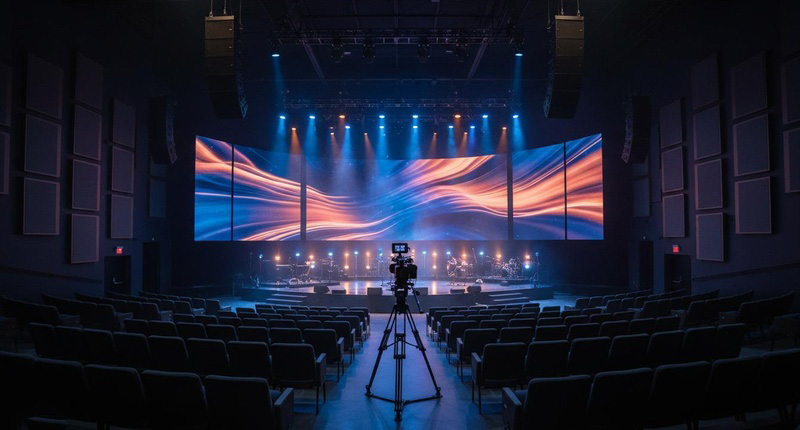
The projection-to-LED migration
| عامل | Lamp/Laser Projection | LED Video Wall | Reseller Implication |
| سطوع | ~200–500 nits equivalent | 800–1,500 nits indoor, adjustable | LED wins in stained-glass sanctuaries |
| عمر | 3,000–20,000 hours | 100,000 hours (10–15 years) | Sell once, service minimally |
| مقابلة | Reflected-light gray blacks | 3,000:1+ | Superior lyric legibility on camera |
| المرونة | Fixed throw ratio, lens limits | Modular; any aspect ratio or curve | Fits historic naves or modern stages |
| 5-Year Maintenance costs | 8,000–15,000 (lamps, labor) | ~$1,500 (spare modules only) | Low maintenance costs in the later stages |
| Livestream | Scan-line artifacts | 3,840–7,680 Hz, camera-safe | Essential for hybrid worship |
The multi-stakeholder sale
What makes church deals tricky: you aren’t selling to one decision-maker. The pastor wants it to look impressive. The volunteer tech operator—typically the person running ProPresenter on Sunday mornings—cares about refresh rate and whether the control workflow makes sense. And the finance committee wants to understand why this costs more than a projector. All three need to say yes.
In 2022, we shipped a P2.9 5×3 m wall to a 400-seat Assembly of God church in suburban Dallas. The pastor loved the demo. The volunteer tech director liked the NovaStar interface. But the deal stalled for four months because the treasurer couldn’t reconcile the 62,000 total against a 4,000 projector replacement quote—until our distributor walked him through the 10-year maintenance cost comparison. The lesson: win the tech operator first (they’ll advocate internally), then prepare a maintenance-cost breakdown for the finance committee before they ask for it.
About This Guide
Search “church LED screen sizing” and you’ll find plenty of checklists aimed at end-user pastors. This guide is written for resellers and integrators—from the factory perspective—covering sanctuary geometries, pixel-pitch calculations, power and structural requirements, and content workflows.
Understanding church spaces: one size does not fit all
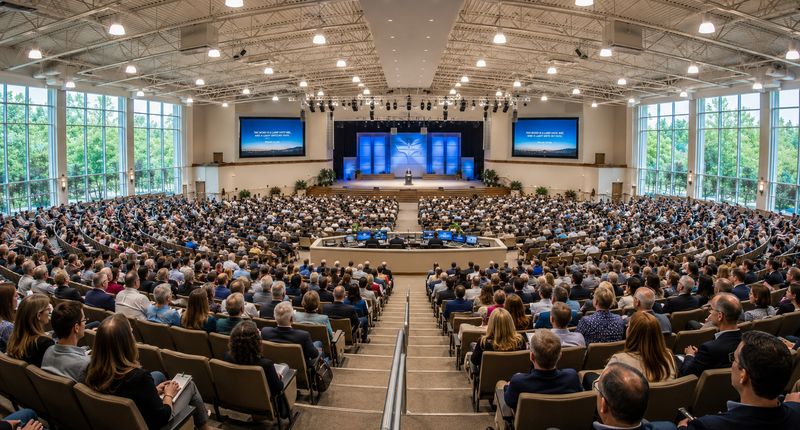
The most expensive mistake resellers make is quoting identical panel specifications for every church on the first call. A 500-seat traditional sanctuary with stained-glass windows demands a fundamentally different product than a 500-seat modern auditorium with blackout curtains and a broadcast suite.
Four space types dominate the North American and European house-of-worship LED landscape:
| Characteristic | Traditional Sanctuary | Modern Auditorium | Fellowship Hall / Multi-Purpose Room | Outdoor Venue |
| Architecture | High vaulted ceilings, fan-shaped pews, stained glass, possible balcony at 20-30 m | Stage-forward design, theatrical lighting, blackout capability, catwalks | Flat ceiling, movable furniture, non-AV-optimized layout | Lawn, parking lot, or temporary stage; no shelter |
| Furthest Viewing Distance | 25-50 m (balcony rear) | 15-30 m (rear row) | 8-15 m | 20-60 m (crowd depth) |
| Ambient Light Challenge | 2,000-5,000 lux from stained glass; variable by season and time of day | Fully controllable; 100-300 lux during service | Fluorescent overhead mixed with window light; 500-2,000 lux | Direct sunlight; 10,000-100,000 lux |
| Primary Content | Scripture text, liturgical slides, occasional video | IMAG camera feed, livestream, motion backgrounds, multi-source switching | Announcements, video playback, overflow simulcast | Baptisms, community events, Easter sunrise |
| Recommended Pixel Pitch | P2.9-P3.9 | P2.6-P2.9 (main); P2.9-P3.9 (side screens) | P2.9-P3.9 | P3.9-P4.8 (stage); P4.8-P6.67 (audience far field) |
| Brightness Requirement | 1,500-2,500 nits to overcome stained glass glare | 600-1,200 nits (camera-friendly in dark room) | 1,000-1,500 nits | 5,000-8,000+ nits |
| معدل التحديث | 3,840 Hz minimum (funerals/weddings often recorded) | 7,680 Hz if livestreamed; 3,840 Hz acceptable if no broadcast | 1,920-3,840 Hz | 3,840 Hz minimum |
| Structural Reality | Plaster/concrete walls may not bear load; church board approval needed | Engineered rigging points standard; easy wall or truss mount | No rigging; ground-stack only; must store between uses | Custom ballast frame or stage truss; wind load critical |
| Installation Type | Permanent wall-mount with front service access | Permanent; wall-mount or flown | Modular quick-disconnect on rolling ground-stack frames | Rental-style flight-case deployment; IP65 required |
| Typical LED Budget | 35,000-85,000 | 50,000-150,000+ (main + side screens) | 15,000-35,000 | 20,000-60,000 (rental-grade durability) |
Space-Specific Engineering Considerations
Traditional church present a dual challenge: brightness and viewing angle. Specifying a 600-nit panel for a Gothic Revival sanctuary with eastern-facing stained glass produces a gray rectangle every Sunday from March through September. These environments demand 1,500–2,500 nits. At the same time, fan-shaped seating with side pews can push attendees beyond 140 degrees off-axis. Standard panels drop color accuracy past 120 degrees; sites with occupied side pews past 140 degrees require wide-viewing-angle SMD packages (160-degree horizontal minimum).
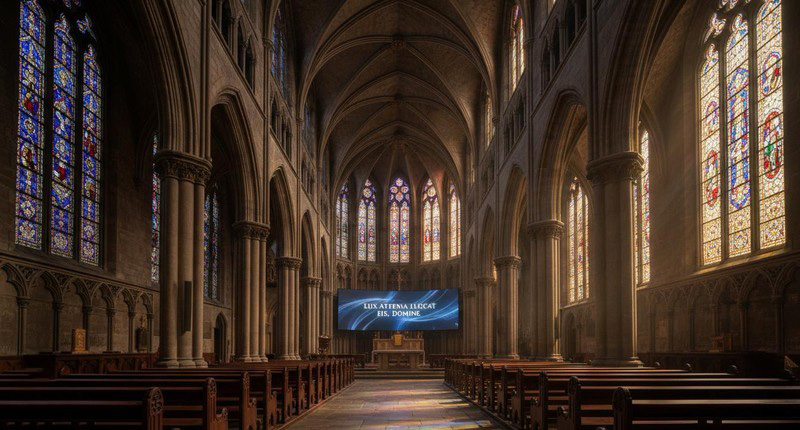
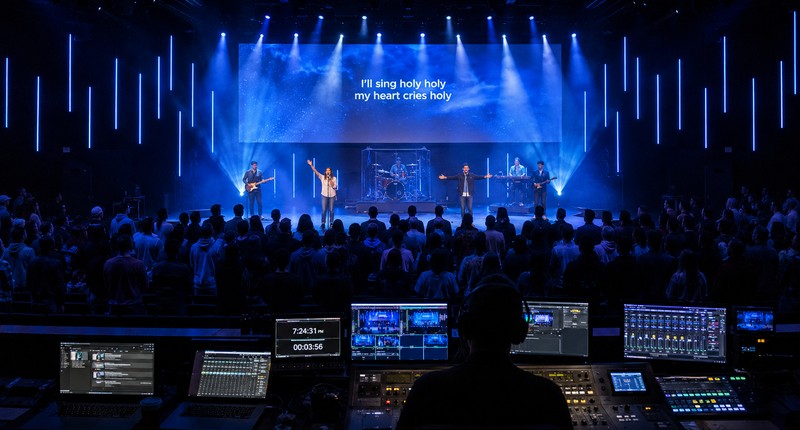
Modern auditoriums demand high refresh rates for broadcast. Any church running a livestream requires 3,840 Hz minimum—at 1,920 Hz, rolling band artifacts appear unpredictably depending on camera shutter phase. Churches with dedicated broadcast suites or multi-campus simulcast benefit from 7,680 Hz panels.
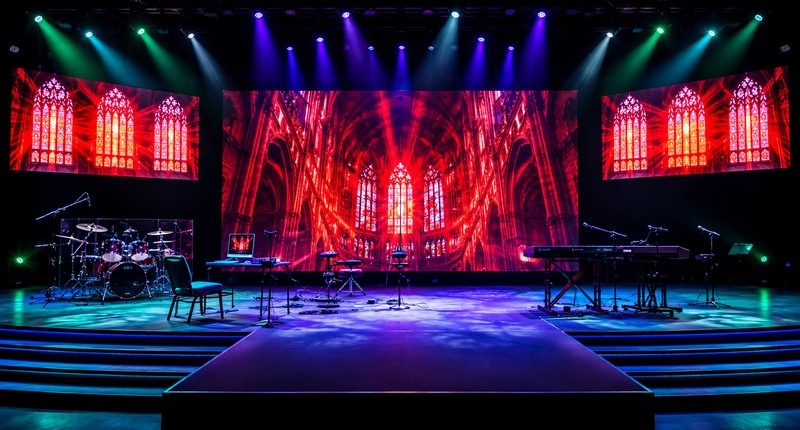
Fellowship halls favor modular ground-stack systems. A volunteer-friendly frame with tool-free latching allows a two-person team to set up or strike the wall in under 20 minutes. Quick-disconnect power and data cabling, packaged in two or three flight cases, stores in a standard supply closet.
Outdoor venues require IP65 cabinet sealing و 5,000+ nits for daylight readability—driving heat generation 20–30% over indoor panels and demands active thermal management. Seasonal deployments benefit from rental-grade flight-case packaging with modular 500 × 500 mm أو 500 × 1000 mm cabinets that scale to crowd size.
Space diagnostic checklist: five questions every reseller must ask on first contact
Resellers with the lowest return rate and highest referral rate in our distributor network run through the same questions on every first discovery call. It takes under three minutes and prevents the majority of mis-specification callbacks:
● “What is the furthest seated viewing distance?” Determines pixel pitch and minimum screen height (distance ÷ 6 to 8).
● “Do you livestream, record, or use IMAG camera projection?” Quote 3,840 Hz minimum; upsell 7,680 Hz for any broadcast ambition.
● “Describe your room lighting: stained glass windows, skylights, or full blackout capability?” Eliminates ~70% of mis-specified brightness callbacks.
● “Who operates your AV system on Sunday mornings—paid staff or volunteers?” Volunteer-run sites need simpler control workflows and more forgiving failure modes.
● “Is this a permanent installation, or do you need flexibility to move or resize the screen?” Shifts the product category from fixed-install cabinets to modular rental-grade frames.
Church LED screen sizing guide: how to calculate the right wall
Viewing Distance Formulas
Every sizing conversation starts with two measurements: distance to the front row (closest viewer) and to the back row or balcony (farthest viewer).
1. Minimum viewing distance (m) = Pixel pitch (mm) × 1. A P2.9 panel requires at least 2.9 m (~9.5 ft); closer than that, individual LEDs become visible.
2. Optimal viewing distance (m) = Pixel pitch (mm) × 3. That same P2.9 panel looks sharpest at roughly 8.7 m (~28.5 ft).
3. Screen height = farthest viewing distance ÷ 6 to 8. A church with a balcony 18 m from the stage needs a screen height of 2.25–3 m. Multiply height by 1.78 for 16:9 width, yielding roughly 4–5.3 m, then round to cabinet multiples.
Church Viewing Zones and Pixel Pitch Mapping
| Viewing Zone | Distance from Screen | Recommended Pixel Pitch | Typical Application |
| Front row | 3–5 m (10–16 ft) | P1.9–P2.6 | Stage backdrop, small chapel main screen |
| Mid section | 8–15 m (26–49 ft) | P2.6–P3.9 | Medium sanctuary primary display |
| Balcony / rear | 15–30 m (49–98 ft) | P3.9–P4.8 | Large auditorium main wall, IMAG screens |
The Front-Row Problem
In a 150-seat chapel where the first pew sits 3 m from the stage, P2.9 appears grainy to close viewers. P1.9 or P2.5 is the safer spec there. Conversely, a 600-seat auditorium with the nearest viewer 10 m away gains nothing from P1.9—the extra resolution is invisible at that distance, while per-cabinet cost jumps 40–60%.
Cabinet Math
Indoor church panels are manufactured on two die-cast aluminum cabinet form factors: 500 × 500 mm و 500 × 1000 mm. Final wall dimensions must be integer multiples of 500 mm.
● 5 m × 3 m using 500 × 500 mm: 10 wide × 6 high = 60 cabinets (exact match)
● 4.5 m × 2.5 m: 9 wide × 5 high = 45 cabinets (exact match)
● 4.8 m × 2.7 m: Not divisible by 0.5 m—round down to 4.5 m × 2.5 m or up to 5 m × 3 m, We recommend rounding up and framing it as “future-proofing room for content expansion.”
Aspect Ratio
16:9 is the default for roughly 85% of sanctuaries—it matches ProPresenter, camera feeds, and lyric software without letterboxing.
21:9 (ultra-wide) suits broad contemporary stages where the church wants lyrics on one side and motion backgrounds on the other. The trade-off is workflow complexity: it requires either 21:9 native content or dual-zone processing, which most volunteer operators can’t manage without additional training.
Custom ratios sometimes emerge from architectural constraints. Unless the church has a full-time media director with After Effects experience, steer them back to 16:9—non-standard ratios add content-creation friction that strains the volunteer team and, eventually, erodes your referral relationship with that church.
Brightness Sizing
For controlled indoor lighting—the majority of churches—800–1,500 nits is correct. Sanctuaries with stained glass, skylights, or south-facing windows need 1,500–2,500 nits. Anything beyond 2,500 nits indoors inflates hardware cost and power consumption, and in a dim worship environment it causes eye fatigue, washes out IMAG skin tones, and overexposes camera feeds.
Panels with auto-dimming (10–100% range) typically run at 50–70% of maximum brightness during services. That reduces power draw by 20–30% and extends LED lifespan toward 80,000+ hours from the 60,000-hour baseline. Inform the customer – lower electricity bills and a longer replacement cycle that they will know how to choose.
Pixel pitch selection: the spec that makes or breaks the sale
Pixel pitch determines whether front-row donors see a seamless image or a grid of glowing dots, and it drives 60-70% of total hardware cost. This is the conversation that matters.
The three tiers of pixel pitch for church LED video walls
| Tier | Pitch | أفضل مسافة مشاهدة | Typical Application | Price vs. P3.9 |
| Premium | P1.9 – P2.6 | 2 – 8 ft | Front-row sanctuaries under 5 m, broadcast studios | 1.5 – 2.0× |
| Sweet spot | P2.9 – P3.9 | 8 – 15 ft | Main sanctuary backdrop; P2.9 for 5-8 m, P3.9 for 8-15 m | 1.0× (baseline) |
| Budget | P4.8 – P6.25 | 12 – 25 ft | Rear walls, side IMAG, overflow rooms | 0.6 – 0.8× |
The premium tier serves churches where the front row sits under 5 m from the stage. At that distance, P3.9 reveals individual pixels. P1.9 costs 1.5-2× what P2.9 does, yet the difference is invisible past row five. We advise spec’ing P2.6 for center stage and redirecting savings into refresh rate or controller redundancy. The audience will notice scan lines on a livestream before they notice the difference between P1.9 and P2.6 from row ten.
The sweet spot tier accounts for roughly 80% of sanctuary display projects we manufacture. P2.9 is the default for mid-size church— its 8.7 ft minimum viewing distance covers the first several pews. P3.9 sits at roughly 20% below P2.9, ideal where the front row starts at 10 ft or more. An LED video wall for churches in this tier balances cost and clarity for the overwhelming majority of congregations.
The budget tier fills a narrow niche. P4.8 works for balcony-facing screens or deep rear walls with viewers 15 m back, but we do not recommend it for main stage backdrops when the front row is within 12 ft. At that proximity, worshippers see pixel structure and lyric text loses readability. I have seen P4.8 spec’d for a main stage where the front row was 8 ft away. The pastor called after the first service to say the lyrics looked “like a crossword puzzle.”
How to Explain Pixel Pitch to a Pastor
Resellers who lead with spec sheets consistently lose the room in church environments. The pastor does not care about 2.9 mm — what they care about is whether it looks sharp to the congregation.
Experienced resellers in this space recommend reframing the conversation around viewer experience rather than technical specifications. Instead of quoting pixel pitch numbers, describe what the audience sees: from the third row back, no individual pixels are visible; from the front row, the image looks as sharp as a television.
For pricing conversations, framing the cost difference as a stewardship issue tends to be effective — the front rows are where major donors sit, and a grainy image at close range sends an unintended message about quality.
One practical recommendation from multiple distributors: bring both P2.9 and P3.9 sample modules to the sanctuary and let the pastor compare them from the front pew. Seeing the difference firsthand eliminates the abstract-spec discussion entirely
Refresh Rate: The Hidden Spec That Kills Livestreams
Refresh rate is the spec factories bury when it is low, and the single most common cause of livestream complaints. A panel at 1,920 Hz looks fine to the human eye, but point a camera at it and scan lines, moiré, and rolling bands appear immediately.
If a church livestreams even once a month, 3,840 Hz is the minimum. Below that threshold, every camera angle captures scan-line artifacts, moiré, and rolling bands that post-production cannot remove. Multi-camera IMAG setups with professional switchers benefit from 7,680 Hz, which also future-proofs against camera upgrades over the next five to seven years.
Budget panels from second-tier factories frequently ship at 1,920 Hz marketed as “HD refresh.” Get written confirmation from the factory, stating the guaranteed refresh rate at standard brightness.
Installation Realities: What to Check Before Quoting
Most U.S. and European churches were built between 1920 and 1960, long before anyone imagined hanging a half-ton electronic display inside them. The majority of post-installation problems trace back to details resellers never verified during quoting.
Mounting Method Selection
Three mounting approaches dominate church installations. Your choice should follow a simple logic: what will the building allow, what will the client spend, and how permanent is this? Lead every site survey with a wall tap test and a conversation with the facilities manager about construction date and wall material.
| Mounting Method | Structure Required | Capacity Needed | Hardware Spec | Relative Cost |
| Wall-mounted | Concrete/reinforced masonry | ≥150 kg/m² | M10–M12 bolts, 40–50 cm spacing | Low |
| Ground-stacked | Level floor + rear access | Floor ≥50 kg/m² | Base plate + rear support truss | Medium |
| Flown/truss-hung | Engineer-rated ceiling | 200–300 kg/m² | Aircraft-grade cable 5,000+ lbs | High |
Wall-mounted is the default. The wall must be load-bearing concrete or reinforced masonry rated for ≥150 kg/m², with M10–M12 expansion bolts at 40–50 cm spacing set with epoxy resin. Drywall cracks under 100 kg/m² وتفشل بشكل كارثي تحت وزن يزيد عن 400 كجم - تتطلب الجدران ذات الدعامات صفيحة دعم فولاذية.
Ground-stacked لا يتطلب أي اتصال بالجدران، ويتم تركيبه في غضون ساعات، كما يسمح بنقله. تحتاج مجموعة بمساحة 5 أمتار × 3 أمتار إلى ما يقارب 6 م × 4 م مساحة الأرضية شاملةً مساحة الهيكل. الخيار الأنسب للمتطوعين.
معلق أو معلق على دعامة يتطلب سقفًا مصنفًا لـ 200–300 kg/m² و كابلات تثبيت من الدرجة المستخدمة في صناعة الطائرات (5000 رطل / 2268 كجم كحد أدنى). يتطلب موافقة مهندس الإنشاءات في جميع الولايات القضائية تقريباً، بالإضافة إلى $3,000–$8,000 أن البائعين ينسون عادةً وضع ميزانية.
إذا كانت قدرة تحمل الجدار على الحد الأدنى، يُنصح باستخدام دعامة أرضية أو معلقة بدلاً من المخاطرة بدعامة ضعيفة. عبارة "يفترض أن يكون الأمر على ما يرام" ليست تقييمًا هندسيًا. احصل على تقييم مكتوب من مهندس إنشائي أو اختر طريقة تثبيت مختلفة.
Power Infrastructure
واجهت مشاريع إضاءة LED في الكنائس مشاكل هنا أكثر من أي منطقة أخرى. صُممت أنظمة الكهرباء في خمسينيات القرن الماضي للإضاءة المتوهجة وآلة صنع القهوة، وليس لجدار عرض بقدرة 5-8 كيلوواط.
يبلغ متوسط استهلاك الطاقة 200-350 واط/م² في الوضع العادي. أما ذروة الاستهلاك، أثناء معايرة اللون الأبيض بالكامل أو عند أقصى سطوع، فتصل إلى 580-700 واط/م². شاشة عرض مساحتها 12 م² تستهلك في ذروة الاستهلاك ما يقارب 7.0-8.4 كيلوواط. عند استخدام جهد 120 فولت في أمريكا الشمالية، يكون الاستهلاك 58-70 أمبير. حتى عند استخدام جهد 230 فولت في الاتحاد الأوروبي، ستحتاج إلى 30-36 أمبير.
| حجم العرض | متوسط السحب | ذروة السحب | دوائر كهربائية بجهد 120 فولت (20 أمبير) | دوائر كهربائية بجهد 230 فولت (16 أمبير) |
| 5 م² | 1400 واط | 3250 واط | 1 مخصص | 1 مخصص |
| 10 م² | 2800 واط | 6500 واط | 2 مخصصان | 1 مخصص |
| 15 متر مربع | 4200 واط | 9750 واط | 3 مخصصة | 2 مخصصان |
| 20 متر مربع | 5600 واط | 13000 واط | 4 مخصصة | 3 مخصصة |
أي شاشة عرض تزيد مساحتها عن ٨ أمتار مربعة تحتاج إلى دائرتين كهربائيتين منفصلتين بقوة ٢٠ أمبير وجهد ١٢٠ فولت، دون أي أحمال مشتركة. قد تحتاج الكنائس المبنية قبل عام ١٩٧٠ إلى ترقية لوحة التوزيع الفرعية. احرص دائمًا على اصطحاب كهربائي لإجراء معاينة الموقع، واجعل الأعمال الكهربائية بندًا منفصلاً في عرض السعر، حتى لا تظهر كمفاجأة بعد توقيع عرض السعر.
إدارة الحرارة: تحتاج خزائن مصابيح LED إلى فجوة هوائية تتراوح بين 100 و150 ملم خلف الجدار لتبديد الحرارة. تؤدي درجات الحرارة الداخلية التي تتجاوز 60 درجة مئوية إلى تقليل عمر مصابيح LED بمقدار 30% تقريبًا، وتسبب تغيرًا ملحوظًا في اللون. يُفضل استخدام التصاميم الخالية من المراوح في قاعات الصلاة، حيث يصبح صوت المراوح مسموعًا أثناء لحظات الصمت في الخطب، وهو أمر لا يمكن لأي كنيسة تحمله.
Signal And Control Systems
يمتد مسار الإشارة في الكنيسة النموذجية من 10 إلى 30 مترًا من كابينة الوسائط الأمامية إلى جدار LED. يوجد جهاز التحكم على الجدار، وليس عند مصدر الإشارة، لذا يُرجى التخطيط لمسار الكابلات عند تقديم عرض السعر.
| وحدة التحكم | منافذ الإدخال | أعلى دقة | الأفضل لـ | مستوى التكلفة |
| نوفا ستار VX4S | HDMI 2.0، DVI، SDI | 4K | جدران الكنائس التقليدية بعرض يصل إلى 8K بكسل | قيمة |
| NovaStar MCTRL R5 | 8 منافذ إيثرنت + منفذان للألياف الضوئية | جدران كبيرة | الجدران العريضة تتطلب تمديد الألياف الضوئية | متوسط المدى |
| برومبتون تيسيرا | SDI، HDMI | 4K | إنتاج تلفزيوني مباشر بتقنية HDR بجودة البث | Premium |
يلجأ المصنعون افتراضياً إلى نوفا ستار: مقابض VX4S 95% من تطبيقات الكنيسة. يلزم استخدام وحدة التحكم MCTRL R5 عندما يتجاوز طول الكابلات 100 متر أو عندما يتجاوز عرض البكسل وحدة VX4S واحدة. تتفوق معالجات برومبتون في معالجة صور IMAG بمستوى البث عند سعره يتراوح بين 3 و 4 أضعاف سعر نوفاستار.
Acoustic Considerations
تُصدر مكبرات الصوت LED -خاصةً تلك المثبتة على منصات خشبية مجوفة- رنينًا بتردد يتراوح بين 60 و120 هرتز. وعندما يُرسل نظام الصوت الترددات المنخفضة عبر مكبرات الصوت الفرعية، تنتقل الاهتزازات إلى هياكل المكبرات، مما يُنتج طنينًا مسموعًا أثناء الصلاة الهادئة وعبر ميكروفونات المنصة.
الحل بسيط، لكن يجب التخطيط له أثناء التركيب: وضع وسادات مطاطية عازلة للاهتزازات بين الصف السفلي من الخزائن والأرضية، مع قاعدة من الخشب الرقائقي الصلب أسفل الوسادات لتوزيع الحمل وتخفيف الرنين. أما في حالة التركيب على الحائط، فتُستخدم حلقات مطاطية عند كل نقطة تثبيت لقطع مسار انتقال الاهتزازات.
Volunteer Training: The Key to Long-Term Satisfaction
توفير ثلاث أدوات للمواقع التي يديرها متطوعون:
● قائمة التحقق من إجراءات التشغيل القياسية المغلفة: تسلسل التشغيل، واختيار المصدر، والضبط المسبق للسطوع، وترتيب إيقاف التشغيل الحرج (إيقاف الإشارة أولاً، ثم وحدة التحكم، ثم الحائط).
● فيديو تشغيل مدته 5 دقائق تم وضع رمز الاستجابة السريعة (QR) على باب الخزانة.
● بطاقة استكشاف الأخطاء وإصلاحها تغطية أهم خمس مشكلات (انعدام الإشارة، إدخال خاطئ، تحول اللون، تجميد الإطار، مزامنة الصوت) مع حلول بخطوة واحدة.
استنادًا إلى ملاحظات موزعينا في أمريكا الشمالية، أفادت الكنائس التي تتلقى جلسة تعريفية منظمة مدتها 30 دقيقة بانخفاض ملحوظ في مكالمات الدعم خلال السنة الأولى. وتُعد هذه النصف ساعة الاستثمار الأكثر فعالية من حيث التكلفة في المشروع بأكمله.
Budgeting And Pricing
From factory cost to church quote
يتراوح سعر المصنع (EXW) في شنتشن لألواح P2.5–P3.9 الداخلية بين 300 و500 تيرا بايت للمتر المربع. لكن تكلفة الشحن إلى الولايات المتحدة تضيف 25 تيرا بايت (رسوم القسم 301)، والشحن البحري (800 إلى 2500 تيرا بايت لكل منصة نقالة)، والتخليص الجمركي، مما يرفع التكلفة الحقيقية للاستحواذ إلى ما بين 35 و50 تيرا بايت فوق سعر المصنع (EXW) قبل تخزين أو اختبار أي وحدة.
| مستوى التكلفة | هامش الربح على الهبوط | سعر الكنيسة للمتر المربع | ما يشمله العرض |
| اللعب التنافسي (اللعب بكميات كبيرة) | 40–70% | $750–$1,200 | لوحات، وحدة تحكم، تركيب أساسي، دعم عن بعد |
| قياسي (خدمة كاملة) | 80–150% | $1,200–$2,000 | يشمل السعر المذكور أعلاه مراجعة الهيكل، وتركيب المعدات، والمعايرة، والتدريب، وضمان لمدة سنتين إلى ثلاث سنوات. |
| بريميوم (مُكامل العلامات التجارية) | 100–200%+ | $2,000–$3,500+ | أعلاه + محتوى مخصص، تكامل صوتي، مدير مشروع، ضمان استبدال مسبق لمدة 5 سنوات |
يشمل عرض الأسعار الشامل سبعة بنود: اللوحات، ووحدة تحكم/معالج الفيديو، ومعدات التثبيت، والهندسة الإنشائية، وأجور التركيب، والمعايرة والتدريب، والضمان مع قطع الغيار. عادةً ما تغطي عروض أسعار المصانع البند الأول فقط؛ وتضيف الملحقات ما بين 20 و40% إلى التكلفة الفعلية.
Typical project budget ranges
| حجم الكنيسة | أماكن الجلوس | مساحة الجدار | سعر مواجه للكنيسة |
| مصلى صغير | أقل من 300 | 6-12 متر مربع | $15,000–$40,000 |
| ملاذ متوسط | 300–800 | 12-30 متر مربع | $40,000–$100,000 |
| قاعة كبيرة | 800+ | 30–80+ م² | $100,000–$300,000+ |
فيما يتعلق بحجم الشاشة، تتناسب التكلفة طرديًا مع مساحة العرض. تشتري الكنائس الصغيرة، التي تبلغ تكلفتها 15,000 دولار، جدارًا واحدًا للمسرح من نوع P3.9 لعرض كلمات الأغاني بوضوح. أما الكنائس المتوسطة، التي تبلغ تكلفتها 100,000 دولار فأكثر، فتضيف شاشات عرض جانبية بتقنية IMAG ومعدلات تحديث عالية الجودة. بينما تتطلب التركيبات الكبيرة التي تتجاوز تكلفتها 200,000 دولار نسب عرض مخصصة، وتكوينات منحنية، وتكاملًا مع بنية البث التحتية.
Hidden Costs to Flag Early
الهندسة الإنشائية: إن تقوية جدار مبني من الطوب يعود إلى عشرينيات القرن العشرين أو إضافة الفولاذ خلف الجدران الجافة يكلف $5,000–$15,000+، ومعامل الأمان 1.5× يعني أن الجدار الذي يزن 400 كجم يحتاج إلى تركيب مصنف لتحمل 600 كجم.
تحديثات كهربائية: يحتاج جدار بمساحة 12 مترًا مربعًا عند ذروة السحب إلى دائرتين مخصصتين 20 أمبير؛ غالبًا ما تحتاج الملاذات القديمة إلى ترقيات لوحة التوزيع - الميزانية $3,000–$10,000.
المعالجة الصوتية: تعكس خزائن LED الصوت بشكل مختلف عن الخلفيات القماشية، وتخلق أسطح المسرح الصلبة صدىً مزعجاً يتطلب امتصاصاً إضافياً.
تمرين: حتى الأنظمة سهلة التركيب تحتاج إلى جلسة تدريبية ميدانية لمدة نصف يوم؛ لذا ضع في اعتبارك تكاليف السفر والعمالة عند تقديم أي عرض سعر، وإلا سيلقي عميلك باللوم على المنتج بسبب أخطاء المتطوعين. كان من الممكن تجنب ستة أشهر من مكالمات الدعم بجلسة تدريبية واحدة.
Six Mistakes That Cost Resellers the Church Job
#1: Asking “how big a screen do you want?” without asking “where does the pastor stand?”
يُحدد موقع المنبر خطوط الرؤية، وارتفاع التركيب، وما إذا كان الصف السفلي من الشاشات يقع فوق مستوى نظر المصلين أو خلف منصة الجوقة. قد تُحجب الشاشة، التي يُحدد حجمها بناءً على مساحة القاعة فقط، بسبب جرن المعمودية الموضوع في المنتصف. لذا، اطلب دائمًا مخططًا لأرضية المسرح قبل تحديد عدد الشاشات، ونحتاجه قبل تقديم عرض السعر.
#2: Treating a 120-year-old sanctuary like a commercial conference room
تُشكّل قيود الحفاظ على المباني التاريخية، والجدران الجصية غير الحاملة، والزجاج الملون الذي يُغمر الغرفة بضوء محيطي بقوة 5000 لوكس، عوامل تجعل تركيب أنظمة الإضاءة بتقنية LED في دور العبادة مختلفًا تمامًا عن أنظمة الصوت والصورة في الشركات. إنّ قيام بائع تجزئة بتقديم عرض سعر لتركيب أجهزة إضاءة مباشرة على الجدران الجافة في صحن كنيسة مبنية من الطوب والخشب تعود إلى عشرينيات القرن الماضي، يُعرّض المبنى لخطر الانهيار الإنشائي. لذا، يُنصح بتخصيص ميزانية تتراوح بين 5000 و15000 دولار أمريكي للهندسة الإنشائية لأي مبنى بُني قبل عام 1960، مع تحديد مستوى إضاءة يتراوح بين 1500 و2500 شمعة/م².
#3: Letting the church “save money” with volunteer labor
يستطيع متطوعو الكنيسة إدارة تمديدات الكابلات وتجميع صناديق النقل. لكنهم لا يستطيعون حساب عامل أمان 1.5× لمجموعة مثبتة على الحائط وزنها 500 كجم، أو توجيه دوائر كهربائية مخصصة بجهد 240 فولت، أو محاذاة شبكة خزائن 10 × 6 بدقة تصل إلى 0.5 مم للحصول على وصلات سلسة. تُنتج الخزائن غير المحاذية فجوات مرئية تتعايش معها الكنيسة لعقد من الزمان. لذا، أصرّ على تركيب معتمد لأي تكوين مثبت على الحائط أو معلق؛ واقتصر على السماح للمتطوعين بالتعامل مع تركيبات التوصيل الأرضي فقط.
#4: Shipping hardware without a content training plan
تتجاوز طلبات الدعم الفني المتعلقة بالمحتوى أعطال الأجهزة بنسبة ثلاثة إلى واحد خلال الأشهر الستة الأولى. الكنيسة التي تستخدم برنامج ProPresenter ووحدة تحكم NovaStar، ولكن بدون متطوعين مدربين، ستُلقي باللوم عليك في حال ظهور كلمات الأغاني غير واضحة. لذا، يُنصح بتوفير جلسة تعريفية مدتها 30 دقيقة، وبطاقة إجراءات تشغيل قياسية مغلفة، وفيديو توضيحي مدته 5 دقائق. تُشير التقارير إلى أن الكنائس التي تُدرّب المتطوعين تُسجّل انخفاضًا في مكالمات الدعم الفني بنسبة 70% في السنة الأولى.
#5: Ignoring the spare parts time bomb
تتغير مجموعات رقائق وحدات LED كل 18-24 شهرًا. كنيسة تحتاج إلى أربع وحدات بديلة في السنة الرابعة تكتشف أن المصنع أوقف إنتاج تلك الدفعة في السنة الثانية. يظهر اختلاف اللون بين الدفعات القديمة والجديدة من الشرفة. الحل الأمثل: اطلب مسبقًا وحدتين احتياطيتين من طراز $800 ووحدة تغذية طاقة احتياطية، واحصل على تأكيد كتابي من المصنع بتوفر قطع الغيار لمدة 3-5 سنوات. استثمارك في مجموعة قطع الغيار $800 يمنع حدوث مشكلة "ظهور بقع على الجدار" التي تحدث مع وحدة $35000.
#6: Not testing refresh rate with the church’s actual camera
إنّ ورقة المواصفات التي تدّعي معدل تحديث 3840 هرتز لا قيمة لها إذا التقطت كاميرا الفيديو التي تبرّع بها القسّ خطوط المسح عند سرعة الغالق هذه. يختلف توقيت مستشعر الكاميرا باختلاف الطراز؛ فما يبدو واضحًا على منصة الاختبار قد يظهر مشوّهًا على شاشة الكاميرا. لذا، يُنصح بتحديد موعد لاختبار الكاميرا قبل تركيبها، مع مراعاة طراز الكاميرا المستخدم في الكنيسة وظروف الإضاءة المعتادة في المكان.
Sourcing from China: what resellers should ask their manufacturer
What a factory-standard shipment actually contains
تأكد من مطابقة عرض السعر مع قائمة المواد هذه قبل تحويل أي دفعة مقدمة.
| عنصر | تخصيص | أساس الكمية |
| خزائن LED | ألومنيوم مصبوب بأبعاد 500×500 مم أو 500×1000 مم | لكل تصميم تخطيطي |
| وحدات LED | 250×250 مم، فتحة أمامية مغناطيسية | 4 لكل خزانة 500×500 |
| مصادر الطاقة | مينويل 5 فولت 40 أمبير (200 واط)، حاصل على علامة CE/FCC | واحدة لكل 2-3 خزائن |
| بطاقات الاستلام | NovaStar A5s Plus-N, pre-installed | 1 per cabinet |
| وحدة التحكم | NovaStar VX4S or MCTRL R5 | 1 per wall |
| Signal cables | Cat5e/Cat6 daisy-chain | Length to layout |
| Power cables | IEC C13/C14, 14 AWG | Per power plan |
| Mounting hardware | Wall brackets or stacking bars | Specified at order |
| Packaging | Flight cases (rental) or wooden crate (fixed) | 6-8 cabinets per flight case |
| Spare modules | 2-5% of total count | 2-6 for mid-size wall |
| Spare power supplies | 1-2 units | Hot-swappable |
| Spare receiving cards | 1-2 units | Pre-configured |
| Toolkit | Magnetic extraction tool, alignment gauges | 1 per shipment |
Lead times and logistics reality
Plan backward from your church client’s go-live date using these hard numbers.
| Phase | Duration |
| Component procurement | 1-2 weeks |
| Cabinet assembly | 2-3 weeks |
| Burn-in testing (72 hr) | 3-5 days |
| Final QC, calibration, packing | 2-3 days |
| Total production | 4-8 weeks |
| Sea freight to US West Coast | 18-25 days |
| Sea freight to US East Coast | 30-40 days |
| Sea freight to EU | 25-35 days |
| Customs + drayage | 3-10 days |
| Total contract to dock | 8-14 weeks |
Air freight cuts transit to 5-7 days but costs 3-5× sea — $8-15/kg. Justified for spare-module emergencies; rarely for full walls.
US resellers must budget an additional 25% Section 301 tariff on Chinese LED modules (HTS 8531.40), assessed on customs-declared value.
Building long-term relationships with churches
Church technology decisions are slow—6–18 months from first quote to PO—but once trust is established, loyalty is high. Churches that have a good experience return for lobby displays, fellowship hall additions, and satellite campus builds. The referral network within denominations is unusually active: one successful project in a district reliably generates multiple inbound inquiries over the following year.
Our longest-running U.S. distributor started with a single Baptist church installation in 2019. By 2024, that relationship expanded to four campuses, and the distributor has completed installs at twelve other churches within the same denomination—all sourced from that one good job.
The resellers who sustain business in this sector position themselves as the church’s technology partner—not simply a panel supplier. That means sizing the wall correctly, verifying the structure, training the volunteers, and being reachable when the livestream drops on a Sunday morning. Pastors remember the person who solved their problem at 7 AM more than the person who shipped the cheapest panels. That reputation is what drives the next six referrals.
Start your next church project
The 300,000+ U.S. churches aren’t a market segment to extract value from and move on. They’re a network where service quality compounds—each well-delivered project makes the next sale easier and the next referral automatic. We’ve been shipping church panels for over five years now, and the pattern is consistent: the distributors who invest time in site surveys, training, and responsive after-sales support end up with the durable business. The ones who treat it as a one-off box sale don’t.